Scientific Climate Scenarios
From possible futures to probable outcomes.
Scientific Climate Scenarios assigns probabilities to alternative climate futures, enabling investors to estimate the expected impacts of the most likely climate pathways.

Scientific Climate Scenarios
From possible futures to probable outcomes.
Scientific Climate Scenarios assigns probabilities to alternative climate futures, enabling investors to estimate the expected impacts of the most likely climate pathways.
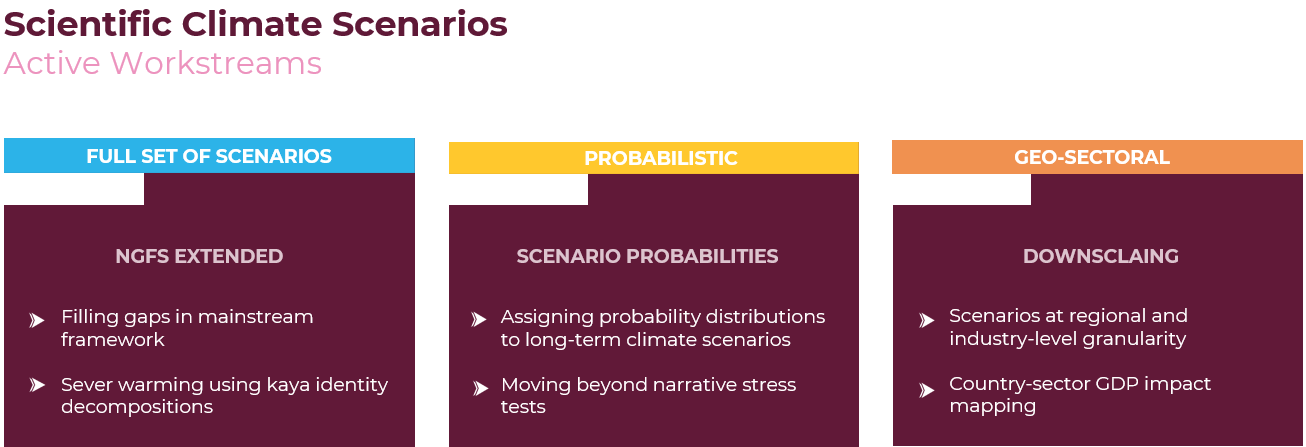
Scientific Climate Scenarios is an advanced climate scenario framework developed by the EDHEC Climate Institute to support forward-looking climate risk analysis and investment decision-making. Building on existing NGFS climate scenarios, the framework extends benchmark scenarios through three key innovations: probability-weighted climate pathways, enhanced country and sector granularity, and expanded climate scenario coverage. While most climate scenarios describe what could happen, Scientific Climate Scenarios estimates the likelihood of alternative climate futures and translates them into actionable insights for investors.

The main users of these probability-aware scenarios will be:
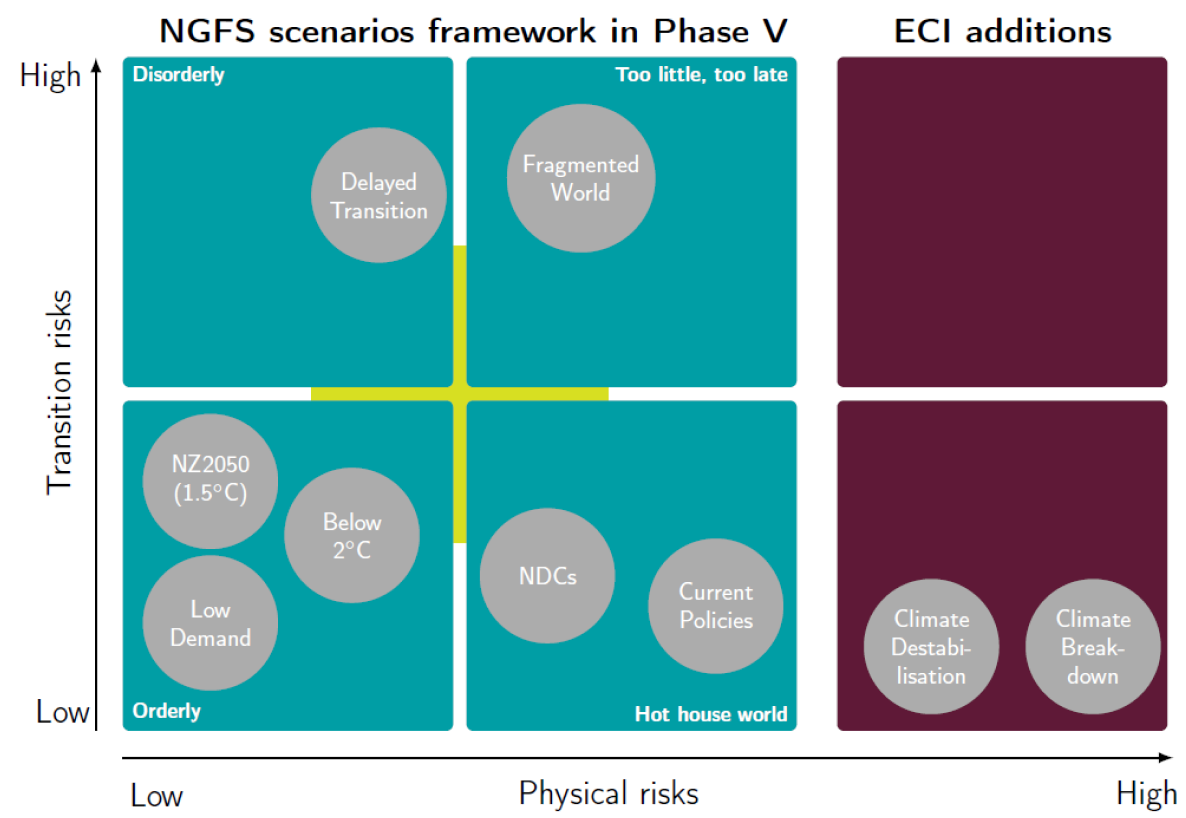
The two additional scenarios, Climate Destabilisation (CD) and Climate Breakdown (CB), are intended to extend the coverage of physical risks in a way that is more consistent with historical trends.
Climate Destabilisation (CD) and Climate Breakdown (CB) temperatures are grounded in IPCC science

Climate scenarios are designed to describe what could happen.
They do not indicate which outcomes are more likely to occur.
International benchmark frameworks such as the IPCC and NGFS provide scientifically robust climate scenarios that explore a range of plausible futures. However, they intentionally avoid assigning probabilities to individual pathways. As a result, scenarios with very different levels of plausibility are often treated equally.
The Scientific Climate Scenarios programme addresses this limitation by assigning probability distributions to climate pathways. This enables investors, policymakers and researchers to move beyond analysing individual scenarios in isolation and estimate the expected impacts of the most likely climate futures.
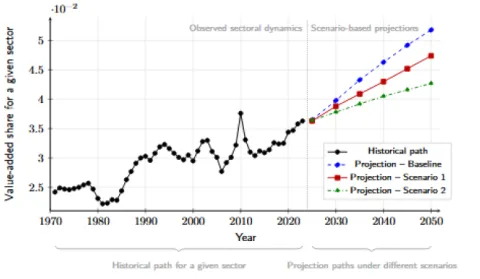
Climate change does not affect every country or every sector in the same way. Current NGFS and SSP-RCP datasets primarily provide information at the country or regional level. However, climate risks materialise differently across sectors through:
As a result, aggregate pathways alone are not sufficient, as the same climate trajectory can conceal very different sectoral transformations.
Introducing country-by-sector granularity provides a more accurate representation of how climate risks emerge across economies and industries.
The NGFS climate scenarios provide an internationally recognised reference framework for climate scenario analysis. However, they are designed as benchmark reference scenarios and do not assign probabilities to alternative climate futures. While the framework covers a broad range of transition pathways, its representation of higher physical risk outcomes remains limited.
To address these limitations, the EDHEC Climate Institute extends the NGFS framework through two additional climate scenarios: Climate Destabilisation (CD) and Climate Breakdown (CB).
These higher-warming scenarios project approximately 3.6°C and 4.4°C of warming by the end of the century, respectively. The extended framework also incorporates additional assumptions relating to physical damages, inflation, GDP, emissions and other macroeconomic variables.
The programme further enhances the NGFS framework by introducing country × sector climate pathways. While NGFS provides climate scenarios across approximately 50 countries and regions, Scientific Climate Scenarios currently covers around 20 sectors per country, with the long-term objective of expanding to approximately 50 sectors.
The programme is a joint collaboration between the EDHEC Climate Institute, Scientific Portfolio, and Scientific Climate Ratings, and is closely linked to the Institute's Physical Risks research programme.
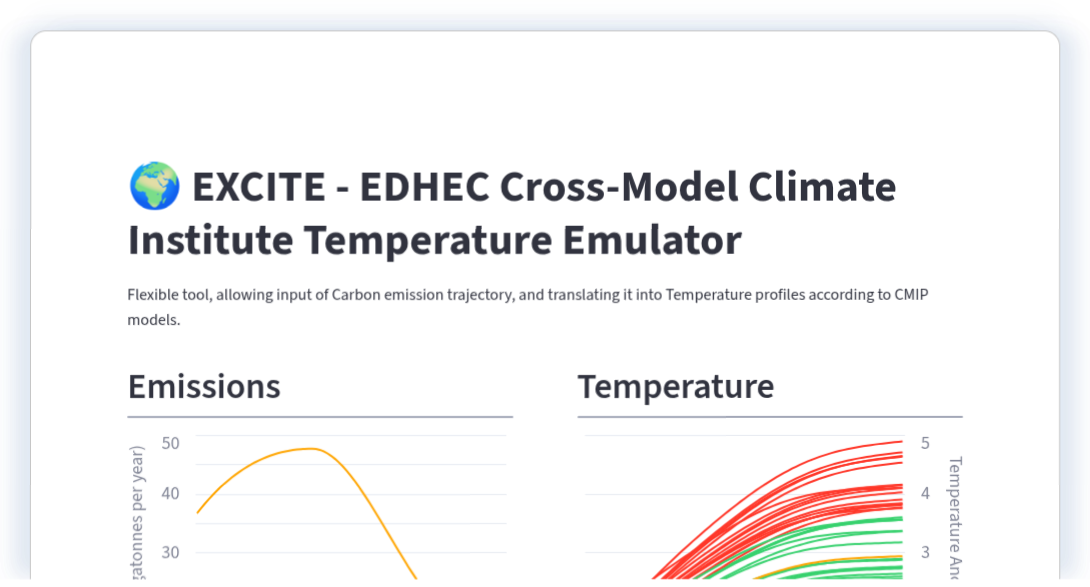
EXCITE (EDHEC Cross-Model Climate Institute Temperature Emulator) is a professionally developed, interactive web-based tool created by the EDHEC Climate Institute. It enables users, including scientists, policymakers, financial professionals, and the broader public, to explore how global surface temperatures could evolve under a wide range of greenhouse gas emissions scenarios.

See more


Edouard Civel
Senior Transition Risk Research Engineer (Paris)



Adham Jaber
Senior Climate Scenario Research Engineer (Paris)