The case for resilience
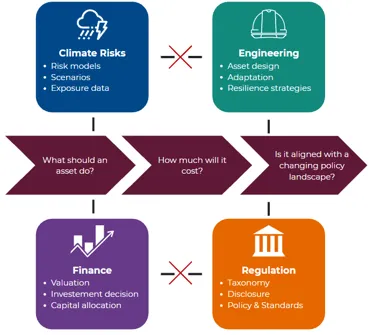
Climate change risks are now a material reality across all sectors of society and the economy. In the global infrastructure sector, the disruption is twofold. On the one hand, the accelerating transition to a low-carbon economy is tightening regulations and shifting markets and consumers’ expectations. On the other hand, infrastructure assets are increasingly exposed to the physical risks of climate-induced weather events.
Misalignment with sustainability criteria and exposure to physical climate hazards can lead to tangible losses and costs.
Yet, resilience is currently underreported by the majority of infrastructure companies[1], highlighting a knowledge gap. In turn, this can lead to missing opportunities, maladaptation and poor investment decisions, in both the private and public sector.
The infrastructure climate resilience gap
ClimaTech – The largest infrastructure resilience strategy database
To address this gap, the EDHEC Climate Institute (ECI) launched the ClimaTech project to:
- Provide a coherent database of strategies to decarbonise industrial infrastructure and strengthen climate resilience
- Enable the assessment of different sector-specific technologies, thus supporting informed decision-making to protect assets and promote sustainable infrastructure
- Advance methodologies and efficiency indicators, based on scientific research and in line with regulatory requirements.
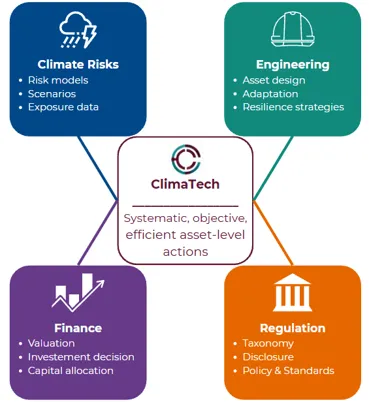
ClimaTech bridges climate science with engineering knowledge to provide actionable financial decisions and regulatory compliance.
Infrastructure classification
ClimaTech uses The Infrastructure Company Classification Standard (TICCS®), a classification system for infrastructure investments, developed by the EDHEC Infrastructure & Private Assets Research Institute[2].
TICCS® uses a hierarchical approach to organize infrastructure assets and enable detailed, asset-level analysis. There are:
- 8 industrial super-classes, which describe broad sector categories (Conventional Power, Transport, Network Utilities, Data, Environmental Services, Renewables, Social Infrastructure and Water Infrastructure),
- 35 sector-specific classes, which further refine the type of infrastructure being analysed,
- 101 industrial asset-level subclasses, which allow asset-level descriptions within the infrastructure super-class.
For example:
Risks classification
Both transition and physical risks are included in the database.
Transition risks, and the corresponding decarbonisation strategies, are categorised into Scope 1, Scope 2 and Scope 3.
For physical risks, ClimaTech includes the strategies to mitigate the impacts of floods, wind/windstorms, heat, and wildfire. These are the most common causes of climate-related asset damage in the last 20 years[3].
The ClimaTech database
To date, the Climatech database is the largest global repository of infrastructure decarbonisation and resilience strategies.
For each infrastructure super-class, there is an in-depth paper, describing the key strategies fore decarbonisation and resilience.
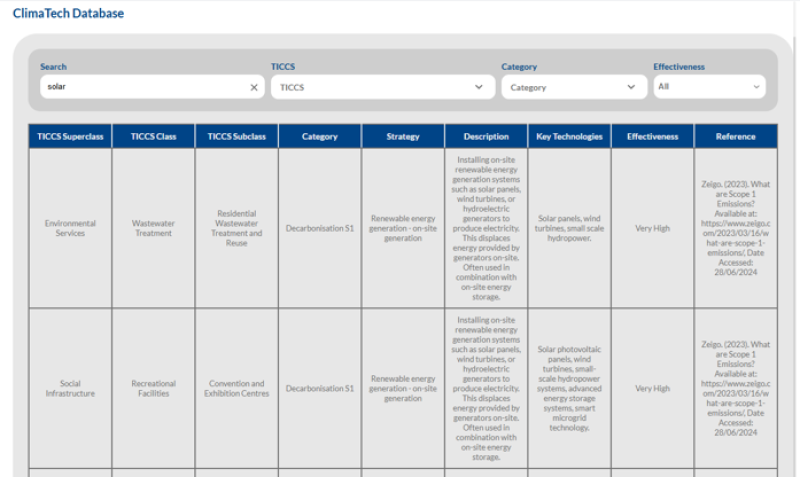
An interactive version of the database is also available at: https://climateinstitute.edhec.edu/climatech-project. It is possible to explore the database using filters. For each strategy and associated technology, an effectiveness is provided. The effectiveness is the result of an extensive review of the scientific literature, company and government reports, and technical documents, currently including more than 200 papers, and periodically reviewed to maintain the ClimaTech body of knowledge up to date.
ClimaTech in practice – Island Airport
We analysed an airport located on an island.
Asset profile
- The only airport in the country
- Critical infrastructure
- Approx 5 m above sea level
Risk profile:
- Floods, sea level rise
- Heat stress
- String winds
TICCS® Classification:
- Superclass: IC60 – Transport
- Class: IC6010 – Airport companies
- Subclass: IC601010 – Airport
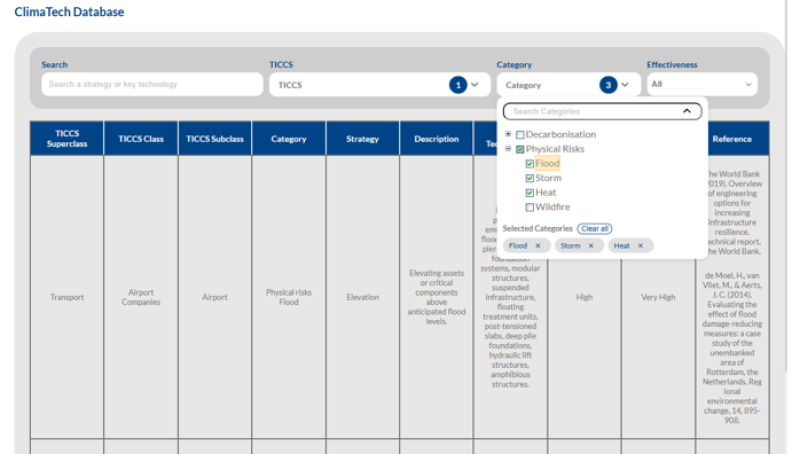
Filtering the database by TICCS class returns 49 physical risk strategies applicable to this asset.
Ww can further refine our search criteria by considering only the risks that are material to the asset, i.e. flood, heat and wind.
It is then possible to filter by effectiveness or level of protection, in order to include in the analysis only the strategies that can efficiently achieve the desired level of resilience in a cost-effective way.
Conclusion
The ClimaTech database makes available a comprehensive list of strategies and technologies tailored to the infrastructure sector. Using the engineering and scientific know-how of the EDHEC Climate Institute, the ClimaTech database provides a reliable source of data and information to address the infrastructure resilience gap.
Work is currently ongoing to extend the database to other assets, including equity and real estate.
Footnotes
[1] Amenc, N., F. Blanc-Brude, A. Gupta, B. Jayles, N. Manocha and D. Marcelo (2023) It’s getting physical. Available at edhec.infrastructure.institute/wp-content/uploads/2023/07/p1102.pdf