Blog
DIRE heatwaves: when climate change becomes an economic risk
Reading time
:
4mn
By Mélodie Trolliet, Senior Climate Research Engineer, EDHEC Climate Institute

DIRE heatwaves: when climate change becomes an economic risk

Available for republication. Media are welcome to republish this article, subject to the EDHEC Climate Institute’s republication guidelines.
Summer 2026 is already standing out as the new indicator of the acceleration of climate change in France. After an exceptional first heatwave as early as May, the country experienced, from 17 June onward, its most intense heatwave episode ever recorded, surpassing that of August 2003. No fewer than 72 Departments were placed under red alert simultaneously, before a third major episode hit a large part of the country on 4 July. Numerous French records were broken: the warmest spring ever recorded, followed by the warmest June ever observed, nearly 500 heat records broken on 22 June, including the hottest night ever observed, and temperatures locally exceeding 44°C. July then closed on a fresh record: with an average temperature of 24.9°C, it became France's hottest month on record since 1900. In early August, a fourth heatwave began and had spread further by mid-August, with up to 67 départements placed under orange alert on 12 August.
Heatwaves are not just breaking meteorological record, they are establishing themselves as a health and economic risk. Here we break down the climate mechanisms behind them, their sectoral consequences, and the effects that linger well after the return to average meteorological conditions.
A heatwave is a period of exceptionally high heat, sustained throughout the day and night and lasting several consecutive days. It usually results from a very particular meteorological configuration.
In Europe, this usually occurs at an altitude of approximately 10 kilometres, where the jet stream, a powerful west-to-east air current, flows and separates cold polar air masses from warmer subtropical air masses. The jet stream shapes the European weather system. However, it sometimes develops large undulations. When these become pronounced, they can cause an atmospheric block, whereby weather systems stop moving forward and remain almost stationary for several days, or even several weeks (Figure 1).
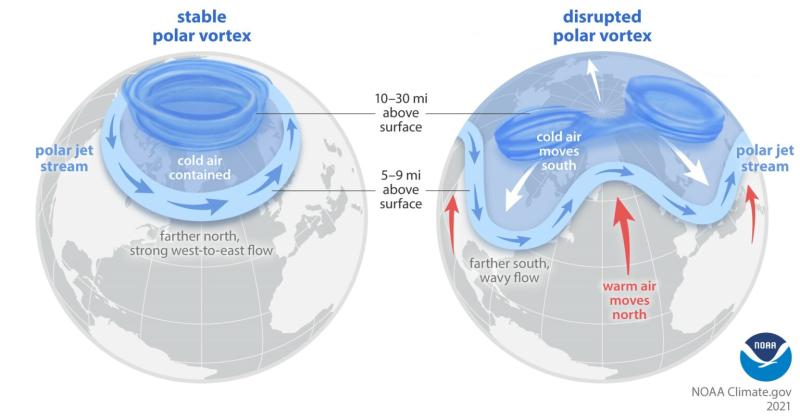
Figure 1: Typical summer circulation (left) versus a blocking situation (right). When the jet stream develops pronounced undulations, weather systems stall and a high-pressure heat dome traps hot air over the continent.
Under these blocking situations, a vast area of high pressure, often called a heat dome, settles in for the long term. The sky stays clear, temperatures climb day after day, and nights no longer allow people to recover from the heat.
It is precisely this type of configuration that set in on several occasions during the summer of 2026. Fed by surges of very hot air coming from the Iberian Peninsula and North Africa, then sustained by a lasting atmospheric block, this mechanism allowed temperatures to remain exceptionally high across a large part of Western Europe for several days.
The weather configurations behind the heatwaves observed during the 2026 summer are not new. What climate change profoundly alters is their characteristics. Climatologist Christophe Cassou has coined a memorable formula to capture this shift. In the same spirit, we propose the acronym DIRE, to capture the main features of climate change-induced heatwaves: Duration, Intensity, Recurrence, and Early onset.
Since the 1950s, the average duration of heatwaves in France has nearly doubled.
The 2026 French temperature record illustrates all four dimensions at once.
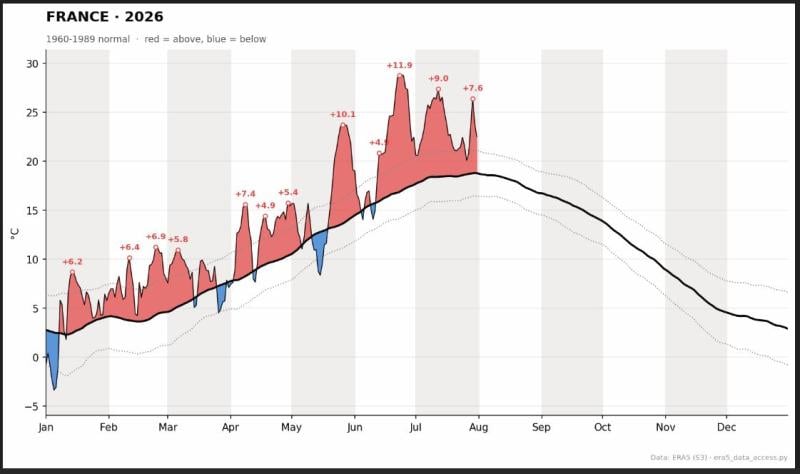
Figure 2: Daily mean temperature in mainland France and Corsica through 2026, against the 1960–1989 normal (black line; dotted lines show the usual range). Red marks days above the normal, blue days below it, with the largest anomalies labelled. Source: EDHEC Climate Institute, ERA5 data.
Figure 2 traces the evolution of daily temperature anomalies since the start of the year (1960–1989 reference period). It highlights a progressive intensification of hot episodes, peaking at nearly +12°C at the end of May, or more than four standard deviations above normal, a statistically exceptional event.
This fourth heatwave will likely not be the summer's last. Against this backdrop, Météo-France published its seasonal trends bulletin for the August-September-October 2026 quarter on 4 August: the most likely scenario remains a persistent anticyclonic blocking pattern over northern Europe, which, combined with climate change, places all of mainland France and Corsica in a warmer-than-normal scenario, in a context still conducive to late-summer heat episodes, though brief cooler spells cannot be ruled out. This body of converging evidence keeps the risk high for new episodes of intense heat, or even a localised heatwave, through the end of summer and into early autumn.
While these prospects point to a persistent risk, this summer’s heatwaves have already had very tangible economic consequences.
The economic consequences of extreme heat events are already visible and fall into four major impact categories: energy systems, living organisms (including human population), agriculture and livestock farming, ecosystems, and infrastructures.
The question of financing these impacts remains largely open. About 95% of the economic losses associated with the latest heatwaves in Europe in 2025 were not covered by insurance, compared with a quarter of losses insured for "traditional" natural disasters (storms, floods). A much more pronounced protection gap for heatwaves than other natural disasters, which leaves most of the cost to be borne directly by households, businesses, and public finances.
The impacts of heatwaves do not stop once temperatures drop. They spread over time and amplify risks in the weeks and months that follow. For example, a warmer sea increases evaporation and the amount of water vapor available in the atmosphere, favouring episodes of intense rainfall and flooding, particularly around the Mediterranean rim. Conversely, the spring rainfall deficit led to a drop in groundwater levels (86% of levels declining as of mid-June), leading to water usage restrictions in several Departments in later weeks.
Heatwaves are thus progressively becoming a structural risk to which businesses, public authorities, and investors must adapt. Understanding, quantifying, and anticipating their consequences is therefore a major challenge. Action can be taken to span three timscales: