Cultural heritage presents a fundamental challenge for climate economics: how should societies assess and protect assets whose loss cannot be compensated by economic growth? Through its research on physical climate risks and their economic consequences, the EDHEC Climate Institute is examining how scientific assessment can inform the preservation of irreplaceable places, works and artistic traditions.
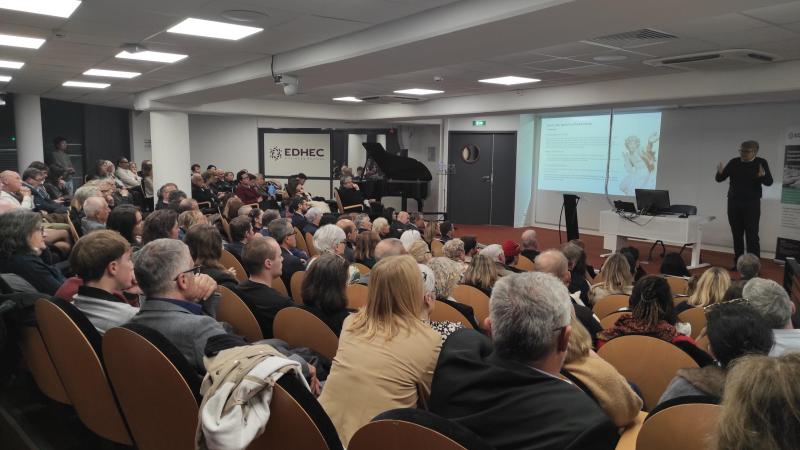
This question was at the heart of Art & Climate, an evening organised with Campus delle Arti on 10 November 2026 at EDHEC’s Nice campus. Before a full auditorium, Professor Noël Amenc delivered a conference entitled “Human Works, Changing Climates”, followed by a concert featuring two young winners of the Campus delle Arti 2025 Prize.
The event forms part of a series of recent conferences and research activities through which the Institute is exploring climate risks to cultural heritage and the economic challenges of adaptation. An economist and Associate Professor of Finance at EDHEC, Noël Amenc has published extensively on investment management and portfolio analysis. His recent Art & Climate lectures examine the risks climate change poses to cultural heritage and the economic questions raised by its preservation.
Accounting for what cannot be replaced
Economic assessments of climate change face a particular challenge when damage involves irreplaceable cultural assets. Discussing neoclassical economics and William Nordhaus’s work on climate-economy modelling, Noël Amenc explored the limits of approaches in which losses can be offset by investment, technological progress or economic growth elsewhere.
A historic city, an original fresco or an archaeological site derives its value from its history, authenticity and relationship with a particular place. Rebuilding a structure or restoring tourism revenues cannot fully compensate for its destruction: economic activity may recover while the cultural loss remains irreversible.
As Noël Amenc observed:
“You cannot substitute Rome for Berlin, or Venice for Port-Grimaud.”
This raises a broader question for climate economics: how can assessments account for irreversible losses and values that market prices do not fully capture? For cultural heritage, the answer has practical implications for adaptation, shaping what societies choose to protect, how they prioritise investment and which resources they mobilise before damage occurs.
Measuring risks to heritage and cultural activity
The analyses presented during the conference illustrated how climate risk assessment can help identify vulnerable sites and inform priorities for protection.
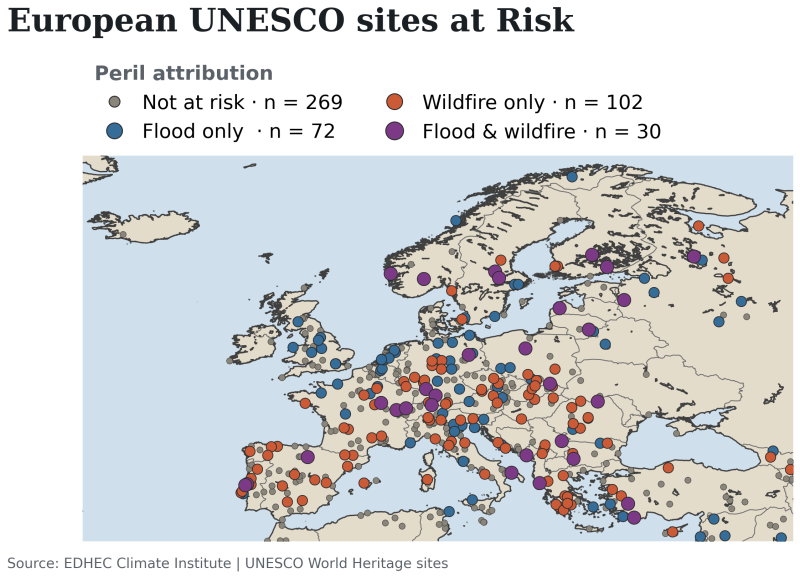
Among the European UNESCO World Heritage sites assessed, 43% received ratings between D and G on an A-to-G climate risk scale. The assessment highlighted risks associated with flooding and wildfires, demonstrating that international recognition does not in itself ensure protection against climate hazards.
The challenge extends beyond sudden disasters. Changes in humidity, heat and moisture conditions can contribute to the deterioration of historic buildings, paintings and archaeological remains. Frescoes illustrate the difficulty particularly clearly: as integral parts of churches, palaces and other buildings, they often cannot be moved to a controlled environment.
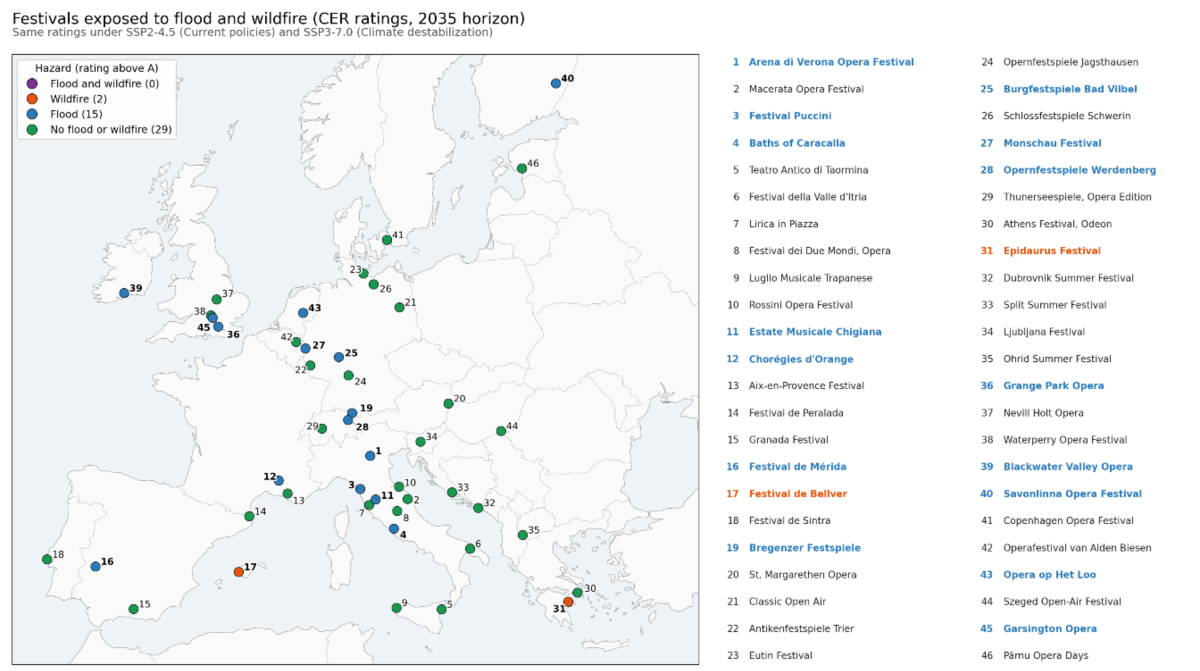
The conference also examined 46 major opera festivals, extending the analysis from the preservation of places to their continued use. For festivals held in historic amphitheatres and open-air venues, extreme heat, flooding and wildfires can affect the safety and comfort of audiences, performers and technical teams. Higher nighttime temperatures may also constrain rehearsals and performances during the summer months.
Adaptation may therefore involve changes to schedules, production arrangements and operating practices, with implications for costs and revenues. Protecting a venue must go hand in hand with preserving its ability to host artistic activity.
Greater adaptation needs and constrained economic resources
The economic geography of climate change adds another difficulty. Regions with exceptional cultural heritage may face substantial climate-related economic losses, potentially constraining their capacity to finance preservation.
Projections presented for European regions, including those encompassing Rome and Florence, illustrated this challenge. Depending on the scenario considered, climate impacts could leave economic output substantially below the level that would otherwise have been reached by the end of the century.
These projections raise a financing question: how can territories meet growing adaptation needs if climate change also weakens their economic resources?
For the EDHEC Climate Institute, connecting assessments of physical risk with their economic consequences can help clarify this challenge. It provides a basis for examining where protection is most urgent, how adaptation investments should be prioritised and how their financing might be shared among public authorities, cultural institutions and private supporters.
Scientific assessment can inform these choices while recognising that the significance of cultural heritage extends beyond its measurable economic contribution.
Preserving the conditions for artistic transmission
The discussion also considered the broader dependencies that sustain cultural life. Musical instruments, for example, rely on natural materials whose availability and quality can be affected by environmental pressures. The conference explored examples including pernambuco used in violin bows and resonance spruce from Italy’s Val di Fiemme.
Such dependencies connect climate and biodiversity risks with instrument making, specialist craftsmanship and access to high-quality instruments. Alongside risks to performance venues, they illustrate how environmental change can affect the conditions through which artistic traditions are passed on.
The concert that followed gave this question of transmission a concrete expression.Introduced by Angela Schiofalo, Artistic Director of Campus delle Arti, German pianist Quentin Wächter and Italian violinist Francesco Finazzi performed a programme bringing together works by Casella, Bach, Ravel, Fauré, Filotei, Paganini and Beethoven.
Themes of water, cities of art and resilience connected the music with the preceding discussion. The programme included Marcello Filotei’s Resistere 3 (The Sound That Remains) and a transcription of Gabriel Fauré’s Pavane for violin and piano.
By placing emerging musicians at the centre of the evening, EDHEC sought to give practical expression to the purpose of preservation: keeping works alive through performance and enabling new generations to interpret and share them.
Connecting research with cultural engagement
For the past two years, EDHEC has supported Campus delle Arti, an Italian initiative that helps talented young musicians access advanced teaching and masterclasses regardless of their financial circumstances.
During the evening, Noël Amenc also presented cooperation with the Maggio Musicale Fiorentino and the Conservatorio di Verona on a prize for emerging musicians without registration fees. He referred to EDHEC’s planned involvement in the French leg of a European tour by La Scala di Milano.
These initiatives reflect an ambition to support artistic talent and the irreplaceable institutions and places that sustain cultural life.
For the EDHEC Climate Institute, the research agenda is equally concrete: better assess the vulnerability of cultural assets, understand the economic consequences of climate impacts and inform adaptation and financing decisions.
The Nice evening brought these commitments together. Preserving cultural heritage means protecting the places and works inherited from the past, while sustaining the people, institutions and performances through which they remain part of contemporary life.
Additional resources