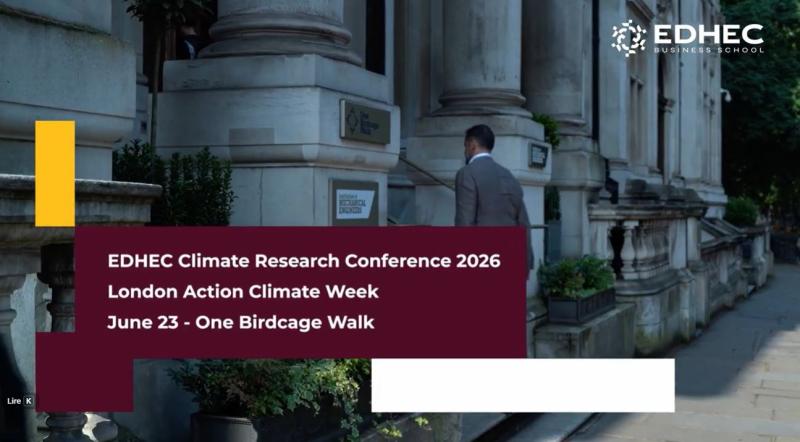
How do you assign probabilities to climate scenarios? Does a highly granular analysis of physical risks change how we assess climate change materiality? Where do carbon tools stand today, and what role are they playing in the transition?
These were among the questions researchers from the EDHEC Climate Institute, alongside partners and associated initiatives, tackled at a major research conference held during London Climate Action Week at the end of June.
The conference brought together leading researchers, investors and policymakers to explore some of the most pressing questions in climate finance, from assigning probabilities to climate scenarios and refining physical climate risk assessment to supporting more effective adaptation, resilience and investment decisions, while highlighting the evolving role of carbon metrics in the transition.
Here are five key insights that emerged from the discussions:
✅ Climate scenarios need probabilities, not just narratives, to better support investment decisions under uncertainty.
✅ Physical climate risk must be assessed at a granular level. Hyperlocal data is essential to understand how climate damages translate into financial materiality.
✅ Adaptation is becoming an investment challenge. Decision-makers need robust tools to identify, compare and prioritise resilience strategies.
✅ Transition risk extends far beyond carbon pricing. Technology, geopolitics, supply chains and changing consumer behaviour are reshaping investment risk.
✅ Climate risk is no longer theoretical. Investors, businesses and policymakers need decision-grade analytics to measure, price and manage its financial implications.
The conference also featured original research, applied case studies and the launch of the Sovereign Climate Risk Rating, a scientific framework designed to assess the macroeconomic impacts of chronic physical climate risk across 191 countries.
👇 Watch the video for highlights from the event, including key speakers, as hundreds of participants gathered for a full day of content and discussion.
In order of appearance:
- Emmanuel Métais, Dean of EDHEC Business School
- Camille Angué, Director of EDHEC Climate Institute
- Anthony Schrapffer, PhD, Scientific Director of EDHEC Climate Institute
- Nishtha Manocha, PhD Manocha, Project Lead of ClimaTech at EDHEC Climate Institute, COO at Scientific Climate Ratings, an EDHEC Venture
- Lionel Melin, Associate Researcher at EDHEC Climate Institute
- Nicolas SCHNEIDER, Ph.D., Senior Research Engineer – Macroeconomist at EDHEC Climate Institute
- Benjamin Herzog, CEO of Scientific Portfolio, an EDHEC Venture
- Rémy Estran-Fraioli, PhD-Fraioli, CEO of Scientific Climate Ratings, an EDHEC Venture