News
From Climate Science to Financial Decisions: EDHEC Research and Innovation in Action at French FinTech Weeks 2026
Reading time
:
3mn

From Climate Science to Financial Decisions: EDHEC Research and Innovation in Action at French FinTech Weeks 2026
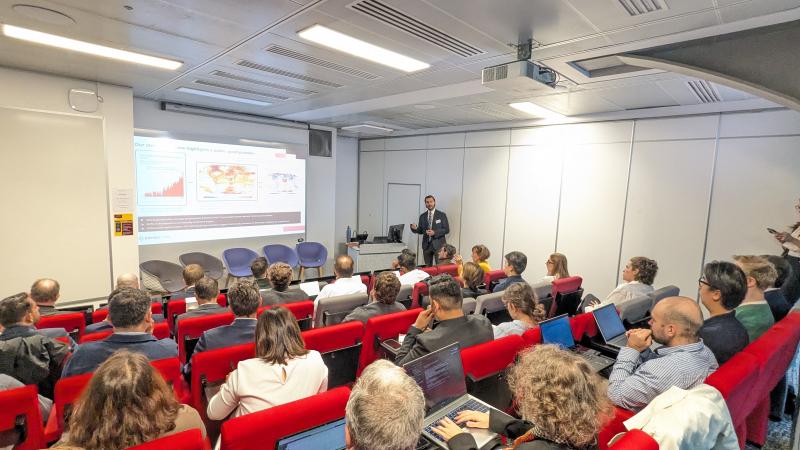
At a conference held in Paris on 8 October as part of the French FinTech Weeks #FFTW26, co-organised by the ACPR, AMF and France FinTech, the EDHEC Climate Institute, Scientific Climate Ratings and Scientific Climate Indices (SciX) brought together researchers, climate data specialists and financial market practitioners to explore how advances in climate science, economic research and financial technology can help translate climate risks into decision-useful information. From probabilistic climate scenarios to asset-level ratings, equity indices and wildfire forecasting, the discussions highlighted both the progress made and the challenges that remain in integrating climate risk into financial decisions.
Opening the conference, Anthony Schrapffer, Scientific Director of the EDHEC Climate Institute, highlighted the estimated €113 billion economic cost of climate-related events in Europe during the summer of 2026, according to Allianz. Representing approximately 0.5% of GDP across the countries concerned, this figure illustrates how extreme weather can affect agricultural production, energy systems, transport and productivity.
Beyond these immediate impacts lies a fundamental challenge: translating climate science into measurable economic and financial consequences.
“Scientists talk about temperatures, precipitation and climate pathways, while financial professionals talk about revenues, CapEx, costs and company valuations.”
— Anthony Schrapffer, Scientific Director, EDHEC Climate Institute
Bridging these perspectives is central to the Institute's research agenda. Climate-related financial impacts depend not only on the hazards to which assets are exposed, but also on their precise locations, economic activities and vulnerabilities. Two assets situated in the same area may face substantially different consequences from the same climate event.
Antony also stressed the importance of looking beyond historical observations. As climate conditions change, past experience alone cannot provide an adequate basis for assessing future risks. Forward-looking scenarios, high-resolution data and economic modelling are therefore essential to understanding potential financial consequences.
Importantly, climate-risk assessment must also account for the actions that businesses can take to reduce their exposure and vulnerability. Through its ClimaTech programme, the Institute is developing approaches to identify and assess adaptation and mitigation measures, linking risk measurement more closely to the evaluation of possible responses.
Nicolas Schneider, Senior Research Engineer and Macroeconomist at the EDHEC Climate Institute, presented recent advances aimed at connecting climate projections with their economic and financial consequences.
A central focus was the Institute's work on Scientific Climate Scenarios, which extends the widely used scenarios developed by the Network for Greening the Financial System (NGFS).
The research introduces two additional high-warming pathways, broadening the range of climate outcomes considered. It also assigns probabilities to different scenarios, allowing researchers to move beyond conventional what-if analysis towards probability-weighted estimates of expected economic impacts.
“The challenge is to combine these scenarios with probabilities, so that you can have a single figure rather than figures specific to each scenario.”
— Nicolas Schneider, Senior Research Engineer and Macroeconomist, EDHEC Climate Institute
This distinction matters for investors. Rather than relying exclusively on the consequences of individual hypothetical pathways, probability-weighted projections can provide an additional perspective for financial valuation and risk management.
The approach does not eliminate uncertainty or replace scenario-specific analysis. As discussed during the audience Q&A, investors can still examine individual pathways and make their own assumptions. The objective is to provide a more comprehensive and transparent basis for decision-making.
Nicolas also presented research examining the economic effects of chronic physical climate risks, particularly the consequences of long-term temperature changes for productivity.
Through EDHEC-CLIRMAP, the Institute makes geographically differentiated projections of physical climate impacts available for exploration. Related research, developed in collaboration with Scientific Climate Ratings, contributes to Sovereign Climate Risk Ratings (SovCRR), which provides projections of climate-related economic impacts across 191 countries and more than 3,400 subnational regions.
These developments illustrate why geographic granularity matters. Climate impacts vary considerably across locations and sectors, and national averages can conceal important differences in economic vulnerability.
The research also aims to strengthen the connection between projected economic damages and financial variables, including cash flows, discount rates and sovereign risk assessments.
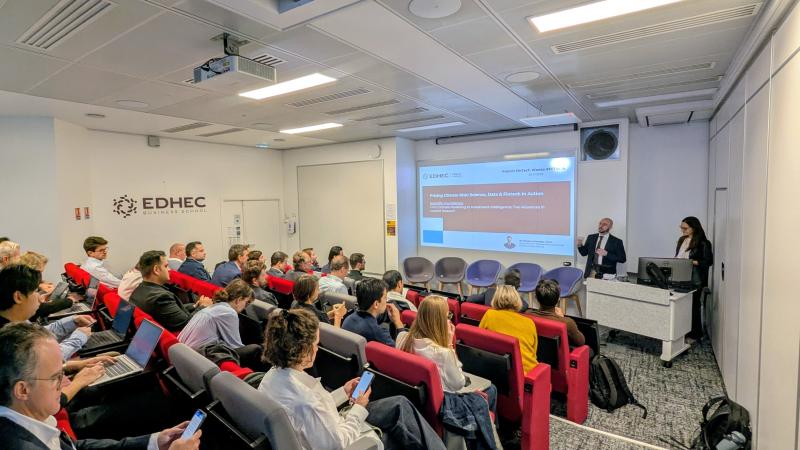
The first panel, moderated by Mariya Peykova of Scientific Climate Ratings, examined how climate research can be translated into practical applications.
The panel highlighted how the EDHEC ecosystem translates scientific research into practical applications through two EDHEC Ventures, Scientific Climate Ratings and Scientific Climate Indices (SciX), alongside EDHEC Climate Innov, a scientific partner of the EDHEC Climate Institute specialising in wildfire risk modelling and operational decision-support tools.
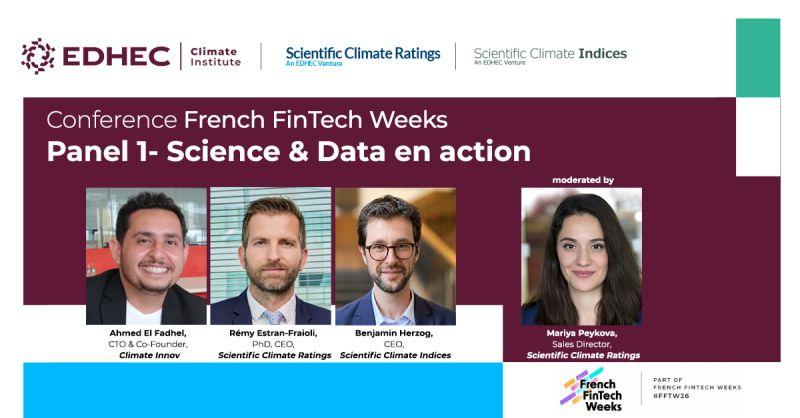
Rémy Estran-Fraioli, CEO of Scientific Climate Ratings, explained how climate-hazard data can be combined with asset-specific vulnerability and damage functions, then incorporated into financial valuation models.
A central point was that similar physical damage does not necessarily translate into equivalent financial losses. The consequences depend on an asset's profitability, financial structure and indebtedness. A 5% loss in the value of a physical asset, for example, could have substantially different implications for a highly leveraged infrastructure investment than for a profitable, low-debt company.
Climate-risk assessment therefore needs to go beyond measuring physical exposure to evaluate its implications for enterprise value, equity and credit risk.
For listed equities, Benjamin Herzog, CEO of Scientific Climate Indices, highlighted a different challenge: incorporating physical climate risk into diversified portfolios while respecting investors' risk constraints.
Unlike individual infrastructure assets, listed companies may operate hundreds or thousands of facilities across multiple geographies. Constructing climate-resilient equity indices therefore requires a balance between the granularity of underlying data, portfolio diversification and tracking-error constraints.
Benjamin explained how country- and sector-level assessments of physical climate impacts can provide a starting point for index construction, with more granular company-level differentiation introduced where data quality and portfolio constraints allow.
A third application was presented by Ahmed El Fadhel, CTO and Co-Founder of EDHEC Climate Innov, whose work focuses on anticipating and managing wildfire risks.
Combining satellite observations, geospatial analysis and physical modelling, Climate Innov is developing tools to help emergency services understand how fires may spread and assess possible interventions.
Its SecuFire Action solution is designed to support operational decision-making by bringing together information on vegetation, terrain, weather conditions and fire propagation.
“You can have the best physical model or artificial intelligence, but without the right data to understand the landscape, it's of no use.”
— Ahmed El Fadhel, CTO and Co-Founder, EDHEC Climate Innov
Ahmed emphasised that artificial intelligence is not necessarily the most appropriate tool for every modelling task. While AI can significantly accelerate satellite-data processing and the preparation of geographic datasets, the company's operational fire-propagation approach relies primarily on physical models.
This distinction reflects the importance of transparency and trust in applications where decisions may have immediate consequences for people, infrastructure and ecosystems.
The discussion also highlighted the role of collaboration between researchers, technology developers and emergency services in testing and improving these tools. Beyond responding to active fires, better modelling can contribute to the longer-term assessment of infrastructure vulnerability and potential adaptation measures.
Across the presentations and panel discussion, several common challenges emerged.
Data availability and quality remain central constraints. Financial institutions need increasingly detailed information on the geographic distribution of corporate activities and assets, while gaps in climate projections and company disclosures can limit the precision of risk assessments.
Transparency and uncertainty are equally important. The discussion of probabilistic scenarios highlighted the need to make assumptions explicit and preserve access to individual climate pathways, rather than presenting probability-weighted estimates as certain predictions.
The panel also explored the opportunities and limitations of artificial intelligence. AI can support data collection, document analysis and geospatial processing at scale, but robust scientific models and appropriate validation remain essential.
Finally, the integration of climate risk into financial decision-making requires more than the availability of analytical tools. It also depends on the ability of financial institutions, companies and other users to incorporate new information into established processes.
The conference illustrated how the EDHEC Climate Institute's research and the complementary capabilities of its ecosystem partners can contribute to this transition: from understanding climate hazards and their economic consequences to developing the information and tools needed to support investment, risk management and adaptation decisions.
To explore the research and applications discussed during the event, access the conference presentation.
To stay informed about our latest research, publications, events and news, follow updates from the EDHEC Climate Institute, Scientific Climate Ratings and Scientific Climate Indices (SciX).