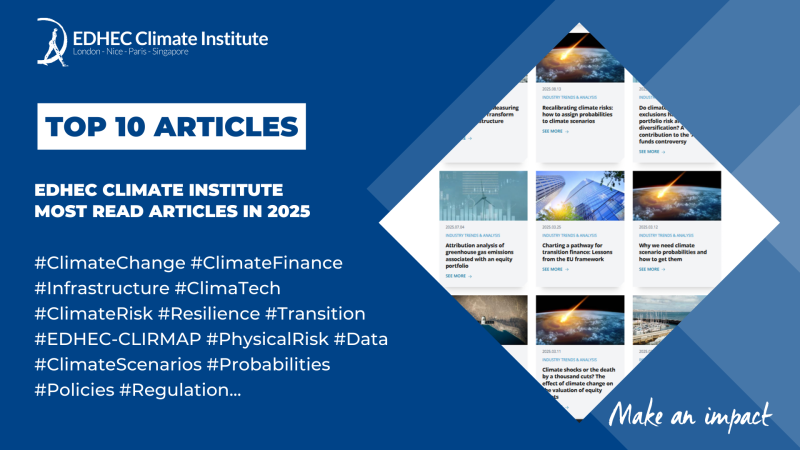
Our most-read publications in 2025 reflect three core priorities: developing granular tools to assess transition and physical risks at the asset and regional level; strengthening scenario analysis and valuation frameworks through probabilistic approaches; and critically examining how sustainable finance regulation, from disclosures to transition finance, can better support real-economy decarbonisation and resilience.
As we begin 2026, we look back at the Top 10 most-read articles of 2025, covering infrastructure resilience, equity valuation, climate scenarios, coastal risk, carbon footprints and the evolving policy frameworks shaping climate-aware finance.
-
This article presents the ClimaTech database, developed by the EDHEC Climate Institute to address the growing exposure of infrastructure assets to climate transition and physical risks. The database provides a systematic, evidence-based assessment of more than 100 decarbonisation and resilience strategies across 101 infrastructure subclasses, evaluating their effectiveness, costs, and uncertainty up to 2050. By moving beyond high-level analyses to deliver asset-level insights, ClimaTech equips investors, asset managers, and policymakers with practical tools to assess residual risks and prioritise mitigation actions.
The database’s practical value is illustrated through a data centre case study, highlighting strategies to reduce emissions while increasing resilience to extreme heat. [Read more]
This article by Conor Hubert, Sustainability Research Engineer (EDHEC Climate Institute); Rob Arnold, Lead Resilience and Decarbonisation Specialist (EDHEC Climate Institute); Nishtha Manocha, Project Lead of ClimaTech (EDHEC Climate Institute), has been originally published in the Investment & Pensions Europe (IPE) and Pensions & Investments (P&I) - special EDHEC Climate Institute supplements.
-
Ten years after Mark Carney’s landmark speech reframed climate change as a systemic financial risk, this article critically assesses the limits of a disclosure-led approach to climate action. While initiatives such as the TCFD dramatically improved climate-related information, they failed to trigger the policy, investment, and innovation shifts needed in the real economy. The article argues that disclosure gradually became a substitute for action, leaving climate policy vulnerable to political backlash and regulatory rollback. To “break the tragedy of the horizon”, the author calls for preserving sustainability reporting while complementing it with credible, durable policy reforms that realign incentives and accelerate the transition to resilient, low-carbon economies. [Read more]
This article by Frédéric Ducoulombier, Programme Director, Climate Regulation and Policies (EDHEC Climate Institute) was originally published in the October newsletter of the Institute.
An abstract of this piece, was published by IPE on 30 September 2025 under the title Viewpoint: The tragedy of the horizon, act II – from promise to peril.
-
This publication synthesises findings from the ClimaTech 2050 Project, a multi-year research initiative led by the EDHEC Climate Institute to address both transition and physical climate risks faced by infrastructure assets. It identifies and evaluates over 100 decarbonisation and resilience strategies across 101 infrastructure asset subclasses, covering sectors such as energy, transport, water, data, and social infrastructure.
Combining engineering evidence, academic literature, and industry practice, the report provides asset-level, decision-ready guidance on emissions reduction and resilience to floods, heat, wind, and wildfires. It offers a practical roadmap for investors and asset owners to strengthen infrastructure resilience while aligning portfolios with long-term climate objectives. [Read more]
Authors: Rob Arnold, Conor Hubert, Nishtha Manocha
-
This article argues that the absence of probabilities in climate scenarios severely limits their usefulness for asset valuation, risk management, and regulatory prioritisation. It proposes two complementary methods to estimate probabilities for climate outcomes: a least-committal (maximum entropy) approach using minimal assumptions, and an informative approach that incorporates economists’ estimates of the social cost of carbon, adjusted for political implementation constraints.
Both methods deliver consistent results, pointing to a median end-century temperature increase around 2.7°C and a 35–40% probability of exceeding 3°C, with a very low likelihood of remaining below 1.5°C. The findings underscore the urgency of stronger abatement policies to shift climate outcomes toward safer trajectories. [Read more]
This article by Riccardo Rebonato, Professor of Finance, EDHEC Business School and Senior Advisor (EDHEC Climate Institute), has been originally published in the Investment & Pensions Europe (IPE) and Pensions & Investments (P&I) special EDHEC Climate Institute supplements.
-
This article analyses how climate change, and especially physical climate risks, can materially affect global equity valuations. Using an integrated climate–macro–asset pricing framework, the study shows that valuation outcomes depend critically on emission abatement policies, the presence of climate tipping points, and state-dependent discounting.
Under weak or delayed abatement, losses exceeding 40% of global equity value are plausible, rising above 50% if tipping points materialise. By contrast, early and robust decarbonisation can limit valuation losses to below 10%, even in adverse physical scenarios. The findings suggest that climate risks remain largely underpriced in equity markets and that prompt policy action acts as a powerful form of financial risk insurance. [Read more]
This article by Riccardo Rebonato, has been originally published in the Investment & Pensions Europe (IPE) and Pensions & Investments (P&I) special EDHEC Climate Institute supplements.
-
This paper presents the scientific and econometric foundations of EDHEC-CLIRMAP, a high-resolution tool designed to assess chronic physical climate risks at the sub-national level. It explains how historical climate and economic data are combined with state-of-the-art econometric techniques to estimate non-linear temperature–growth relationships across 3,600+ regions worldwide.
By integrating NASA CMIP6 climate simulations with empirically calibrated damage functions, the framework projects future impacts on gross regional product under multiple scenarios and time horizons.
The paper shows that regional heterogeneity is central to understanding climate damages, and that relying on national averages can significantly underestimate long-term economic risks for investors and policymakers. [Learn more]
Author: Nicolas Schneider, Senior Research Engineer-Macroeconomist (EDHEC Climate Institute)
-
This article examines why coastal infrastructure, including ports, transport networks and energy systems, is among the most exposed asset classes to physical climate risks such as flooding, storms and sea-level rise. It highlights how the geographic concentration of critical infrastructure amplifies economic and social vulnerabilities and underscores the need for rigorous, comparable risk assessment frameworks.
Drawing on methodologies developed at the EDHEC Climate Institute, the article explains how physical and transition risks can be quantified using hazard probabilities, damage functions and financial materiality metrics. By showing that coastal flood damages could increase dramatically without action, it underlines why accurate risk measurement is a prerequisite for effective investment, adaptation and resilience-building decisions. [Learn more]
An abstract of this piece, by Anthony Schrapffer, Scientific Director (EDHEC Climate Institute), was published by The Conversation on 30 December 2025 under the title Coastal regions and climate change: how better risk assessment can help protect infrastructure and livelihoods.
-
This policy note reviews how Environmentally Extended Input-Output (EEIO) analysis has transformed our understanding of carbon footprints. It shows how EEIO traces emissions across supply chains and allocates them to final demand.
The note synthesises insights from studies of household consumption, investment, and government spending as key drivers of final demand, and highlights emissions mitigation levers in developed and developing countries, and across income groups. It also discusses methods to reallocate capital investment emissions to consumption, showing how they affect country-level footprints and generate new sectoral insights to inform fairer and more effective climate strategies. [Learn more]
Author: Frédéric Ducoulombier
-
This article examines why transition finance, essential for decarbonising high-emission sectors, remains poorly supported within the EU Sustainable Finance Framework. It shows how the Taxonomy Regulation, SFDR and EU Climate Benchmarks, despite their ambition, collectively disincentivise transition investments through overly restrictive criteria, excessive interpretative leeway, and backward-looking metrics.
Drawing on private-sector initiatives and recent guidance from the European Commission and ESMA, the article argues for an extended taxonomy distinguishing sustainable, transitional and unsustainable activities, stronger transition plan disclosures, clearer product classifications, and redesigned benchmarks. It concludes that integrating science-based pathways, transparent reporting and public-private collaboration is critical to scaling transition finance and directing capital toward real-economy decarbonisation at scale. [Learn more]
This article by Frédéric Ducoulombier, Programme Director, Climate Regulation and Policies (EDHEC Climate Institute), has been originally published in the Investment & Pensions Europe (IPE) and Pensions & Investments (P&I) special EDHEC Climate Institute supplements.
-
This article demonstrates why physical climate risk is fundamentally spatial and cannot be captured by national or global averages. Using EDHEC-CLIRMAP, the analysis identifies regional climate risk hotspots across North America, Europe and Asia, highlighting sharp contrasts between local winners and losers.
Coastal, low-latitude and densely urbanised regions emerge as the most exposed to severe economic losses, while some inland or higher-latitude regions may experience temporary gains from warming.
By grounding model outputs in scientific and policy literature, the article shows how granular, region-level insights are essential for investors seeking to anticipate material climate impacts on assets, portfolios, capital allocation decisions, and long-term risk management strategies. [Learn more]
Author: Nicolas Schneider, Senior Research Engineer-Macroeconomist (EDHEC Climate Institute) and Alice James, Writer (EDHEC Climate Institute).
Stay tuned to our website to be informed about future EDHEC Climate Institute research.
To subscribe to our complimentary newsletter, contact us at: [email protected].