- ClimaTech bridges the gap between TICCS® and the EU Taxonomy. By mapping TICCS® infrastructure subclasses to EU Taxonomy environmental objectives and overlaying ClimaTech strategies, we create concrete, asset‑level routes to risk reduction and taxonomy alignment.
- ClimaTech identifies the best ways for assets to defend themselves from the risks of climate change. It identifies mitigation and adaptation strategies, showing how already covered assets can reduce transition and physical risks.
- ClimaTech addresses coverage gaps and stranding risk. Where the EU Taxonomy excludes sectors, such as for fossil fuel infrastructure, ClimaTech identifies strategies that can materially lower emissions and climate-related financial losses.
- ClimaTech links strategy choice to Taxonomy eligible activities. As 85% of all our strategies are Taxonomy eligible, ClimaTech enables investors to select interventions that reduce quantified climate risk and aid alignment with the EU Taxonomy at asset and portfolio level.
Introduction
Infrastructure assets are integral to the proper functioning of the global economy and society. However, these essential systems are simultaneously exposed to both transition and physical risks as climate policy tightens and climate impacts intensify.
- Transition risks refer to the financial risks to infrastructure assets from failing to transition to a low-carbon economy. These can manifest as operational limits on non-compliant assets or regulatory fines.
- Physical risks mean direct damage to assets or operational downtime from increasingly frequent and severe weather events driven by climate change.
That makes the interaction between the Infrastructure Company Classification Standard (TICCS®) and the EU Taxonomy crucial to infrastructure investors as it determines how primary activities are classified, the potential for climate risk mitigation, and ultimately the prospects for capital access and stranding risk across asset subclasses.
This article presents key findings from an upcoming EDHEC Climate Institute study. By linking TICCS® subclasses to EU Taxonomy objectives, we use the ClimaTech database of decarbonisation and resilience strategies to create a data-driven framework for evaluating how infrastructure assets can reduce climate-related risks in line with the Taxonomy.
What are infrastructure assets?
Infrastructure comprises the basic physical and operational systems that underpin the functioning of modern economies. They comprise physical assets such as roads, pipelines, and buildings such as hospitals that perform vital services to society. These assets tend to be physically large, capital intensive, and often involve some form of governmental input, whether through funding, regulation, or oversight. Due to the high capital requirements for new or upgraded infrastructure projects demand often outstrips supply, with the investment required to meet demand estimated at $106 trillion by 2040 (McKinsey & Company, 2025).
How does climate change affect infrastructure?
Infrastructure plays a dual role in climate change, as both a driver and solution. For example, some energy sector assets such as fossil fuel fired power plants directly increase greenhouse gas emissions. However other energy sector assets such as renewable energy plants are vital to a low-carbon economy, despite high energy inputs required during the manufacturing process (International Energy Agency, 2025). The ubiquitous and interconnected nature of infrastructure systems mean they have direct influence on over 90% of all anthropogenic greenhouse gas emissions (Jones, 2016).
Aging infrastructure was often built to suit a more benign climate. It now faces both direct physical damage from extreme weather and indirect risks such as reduced operational capacity from disruption. Existing infrastructure will need upgrading, and new infrastructure must be designed to withstand higher environmental stresses to combat this increased risk (Kitamori & Mullan, 2025).
What happens if infrastructure fails?
The consequences of infrastructure failure can be devastating. The catastrophic failure of New Orleans’ flood protection infrastructure during Hurricane Katrina was directly responsible for approximately two thirds of the total death toll (ASCE, 2007), eventually costing $125 billion in damages in 2005 dollars (Knabb, Rhome, & Brown, 2006). Even when physical damage to infrastructure is avoided, extreme weather causes operational losses due to downtime or delays. In the UK Network Rail calculates that the operational costs purely from weather-based delay compensation is £123m annually (Network Rail, 2024).
From TICCS® to the EU Taxonomy
For infrastructure investors two taxonomies are essential to understanding how sustainable their investments are and could become.
The Infrastructure Company Classification Standard (TICCS®) defines what asset types count as infrastructure and what sector they fall into. Developed by EDHEC Infra & Private Assets in 2018 and updated biennially (EDHEC Infrastructure & Private Assets Research Institute, 2026) TICCS® classifies infrastructure assets into different industrial activities based on the relevant sector, with eight superclasses, 35 classes and 101 subclasses of asset type. It also includes separate classifications of business risk, geo-economic exposure, and corporate structure, however for this analysis only the industrial activity was the focus.
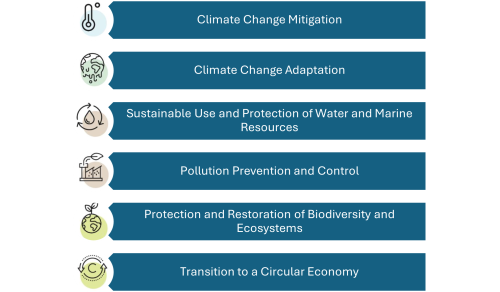
The EU Taxonomy is an economy-wide classification system used to aid investors to identify sustainable economic activities (European Commission, 2026). It establishes detailed criteria for what constitutes a sustainable economic activity: making a substantial contribution to at least one of the six EU climate and environmental objectives (see Figure 1), whilst not doing significant harm (DNSH) to any of them, and meeting minimum safeguards. Each activity must also meet specific technical criteria.
Figure 1: The Six Environmental Objectives Under the EU Taxonomy
Activities under the EU Taxonomy are classified into four categories:
- Eligible: Those that meet all the EU Taxonomy criteria for a given environmental objective.
- Enabling: Enabling activities mean those that may not be inherently sustainable themselves but are critical supporting activities to permit eligible activities to take place. For example, manufacturing solar panels is energy intensive but enables renewable energy deployment.
- Transitional: Transitional activities are defined as stop-gap activities that cannot currently be replaced by lower-carbon alternatives in an economically and technologically feasible way but are intended to be replaced by low-carbon technologies as they become available.
- Ineligible: We consider activities ineligible if an activity is excluded from the Taxonomy.
The purpose of the Taxonomy is to direct capital towards sustainable investments that are required to fulfil the goals of the greening of the EU’s economy by providing a common tool and language around sustainable activities.
The ClimaTech project: strategies and metrics
The third piece of the puzzle is ClimaTech (EDHEC Climate Institute, 2026), a database of climate risk reduction strategies that asset owners can implement to reduce the transition and physical risks to their infrastructure assets. Based on the TICCS® classification it has over 1,800 combinations of strategies and asset types, each with a systematic and comparable risk reduction factor.
By mapping how TICCS® infrastructure assets are classified under the EU Taxonomy, and then how the ClimaTech strategies are classified, investors can understand how sustainable infrastructure assets currently are, and vitally what can be improved.
We have assessed infrastructure assets and their eligibility under the EU Taxonomy in two principal ways:
- Primary activity eligibility: Whether the main economic activity of an infrastructure asset qualifies as eligible under the EU Taxonomy.
- Strategy eligibility: Whether relevant ClimaTech climate risk-reduction strategies available to asset owners are themselves Taxonomy-eligible.
This dual approach reveals the current sustainability status of infrastructure assets and the potential pathways available for improvement.
Pioneering new research by the EDHEC Climate Institute’s ClimaTech team has mapped for the first time how those two taxonomies interact and what the implications are for investors. We answer fundamental questions as: how well is infrastructure covered under the EU Taxonomy; and: how much scope is there for infrastructure assets to reduce climate-related risks? Our analysis can be used to screen investment priorities and provide usable information to investors on viable risk reduction pathways within the framework of the EU Taxonomy.
Infrastructure under the EU Taxonomy
How well does the EU Taxonomy cover infrastructure?
Using the primary economic activity of assets as the determinant of eligibility, EDHEC Climate Institute research reveals comprehensive but uneven coverage:
- 87% of infrastructure asset subclasses are classified as eligible, enabling, or transitional under at least one EU Taxonomy objective.
- Only 13% of all infrastructure asset types are completely ineligible for all environmental objectives.
- Of those ineligible assets, 70% of these are assets related to the fossil fuel supply chain.
Given the criticality of infrastructure to economic and social functioning, the Taxonomy provides substantial coverage. However, this headline figure masks important sectoral gaps.
There are notable gaps in infrastructure asset coverage by the Taxonomy
Fossil fuel infrastructure is notably excluded from the Taxonomy, as expected, since these activities related cannot be considered as sustainable within this framework. This includes activities related to the full fossil fuel supply chain, from extraction and refining, through to transportation of fuels, and finally the burning of these fuels in power generation assets.
There is an exception made for gas assets in a transitional role as the energy system decarbonises with gas filling a currently hard-to-replace niche of dispatchable, high-capacity output. These activities are subject to strict limits on environmental performance, including emissions limits, are often timebound, and are intended to be phased out as new technologies become available.
Data transmission infrastructure presents a significant gap. While data storage assets (data centres, broadcasting) are explicitly included, the supporting transmission infrastructure required to enable these activities is missing - a critical oversight given the essential role of digital infrastructure.
Social infrastructure is only partially covered. For example, emergency services are included, but other health related activities like non-emergency services provided by hospitals and clinics are excluded. The logic behind this binary inclusion or exclusion of specific social infrastructure related activities is unclear and limits the Taxonomy's utility for social infrastructure investors.
How treatment varies across objectives and sectors
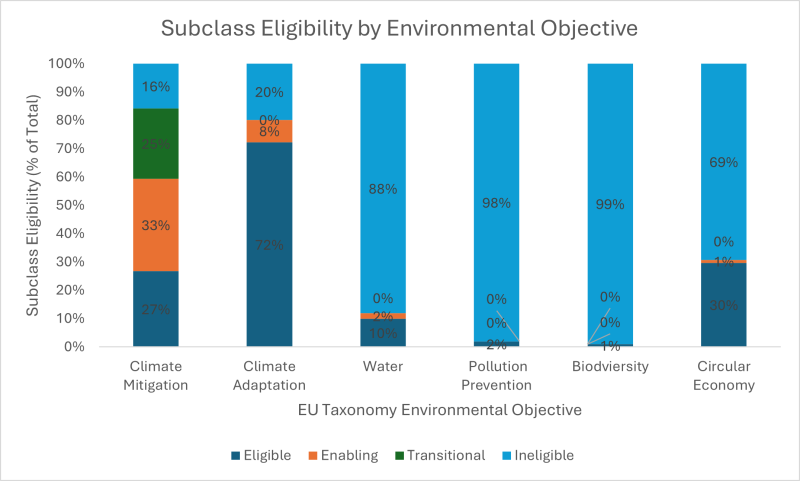
Using the TICCS® asset definitions, EDHEC Climate Institute research shows that infrastructure asset eligibility is highly concentrated (see Figure 2):
- Over 80% of infrastructure asset subclasses are eligible, enabling or transitional under either the Climate Change Mitigation or Climate Change Adaptation Taxonomy objectives.
- This percentage increases to 87% if all environmental objectives are considered.
- However, coverage drops sharply for the other environmental objectives:
- Approximately a third are eligible under the Transition to a Circular Economy objective.
- A tenth are eligible for the Sustainable Use and Protection of Water and Marine Resources objective.
- There are negligible eligible subclasses for the Pollution Prevention and Control, and Protection and Restoration of Biodiversity and Ecosystems objectives.
Figure 2: Subclass Eligibility by Environmental Objective – Eligibility is much more prevalent across climate mitigation and adaption
This highlights that whilst infrastructure assets are critical to achieving some European sustainability goals, they are not a solution for all environmental challenges.
Climate mitigation and adaptation objectives treat infrastructure differently
When focusing on the two most relevant environmental objectives, Climate Change Mitigation and Climate Change Adaptation, it becomes clear that there are nuances between the two. This has knock-on effects on the eligibility of infrastructure assets.
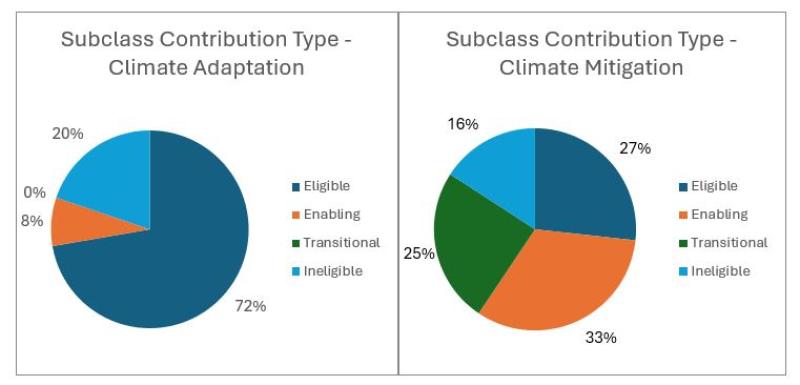
Eligibility rates diverge sharply (see Figure 3):
- Climate Change Mitigation: 27% of infrastructure assets eligible.
- Climate Change Adaptation: 72% of infrastructure assets eligible.
Figure 3: Subclass Eligibility for the Climate Mitigation (Left) and Climate Adaptation (Right) EU Taxonomy Environmental Objectives.
Two factors explain this disparity:
- Precision of criteria: Mitigation activities face highly detailed, stringent eligibility criteria that infrastructure assets must satisfy. Adaptation criteria are broader, with greater scope for interpretation, resulting in higher infrastructure eligibility rates.
- State of knowledge: Transition risk is better understood than physical risk. Consequently, the EU Taxonomy sets more detailed intermediate compliance steps for Mitigation, creating a greater distribution of asset eligibility classifications across this objective.
This difference has important implications: decarbonisation strategies cluster under Mitigation, while physical resilience strategies are more relevant to Adaptation and the Water and Marine Resources objective.
ClimaTech strategies give pathways to improve the sustainability of all Infrastructure Assets
Taxonomy-eligible assets can significantly improve
Whilst the EU Taxonomy covers 87% of asset subclasses, this does not represent the end of the sustainability story. Each of these asset subclasses has applicable strategies that can further reduce their transition and physical risks.
The ClimaTech project takes all the infrastructure subclasses within TICCS® and details relevant strategies that asset owners can apply to reduce either greenhouse gas emissions or the damage from extreme weather events. Even asset types widely considered already to be sustainable can further improve. For example, renewable energy assets have low transition risk but can reduce their vulnerability to physical risk by increasing resilience.
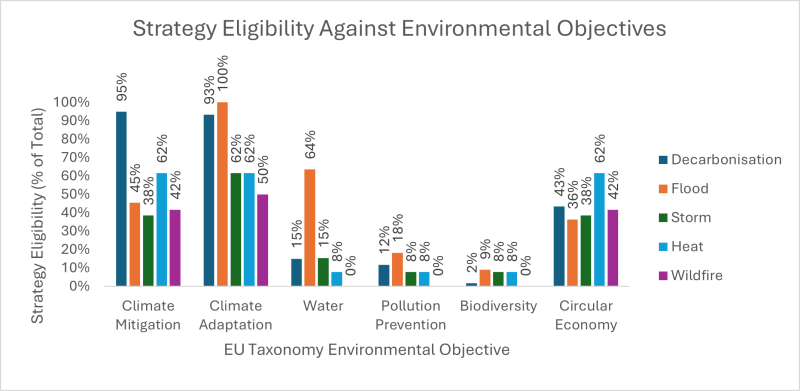
Importantly, 85% of ClimaTech strategies are themselves Taxonomy-eligible activities (see Figure 4):
- 95% of decarbonisation strategies qualify as eligible.
- 73% of physical resilience strategies qualify as eligible.
Figure 4: Decarbonisation and Resilience Strategy Eligibility for each Taxonomy Environmental Objective.
This two-layer approach of combining primary activity eligibility with strategy-level improvements, provides asset owners with a credible path for demonstrating Taxonomy alignment. This, in turn, has implications for reporting as alignment must be demonstrated for inclusion in Article 8 and 9 funds.
Stranded assets still have viable improvement options
Of the 13 infrastructure asset subclasses that are completely excluded from the EU Taxonomy, the majority are fossil fuel assets. These assets face stranding risk as the EU economy decarbonises. If we consider transitional assets (those classified as transitional under the Climate Change Mitigation objective) are also included at risk of stranding, this proportion rises to 41% of all infrastructure asset types.
Critically, all of the TICCS® subclasses, including the fully ineligible and transitional assets, have applicable ClimaTech strategies. These assets can significantly cut emissions and reduce potential operational disruption or physical damage, reducing the risk of climate-related financial losses in the future.
Many ClimaTech strategies for these sectors are technologically mature with well-established supply chains. An additional benefit is they often improve operational efficiencies, reducing both emissions and operating costs, particularly from fuel, heat and electricity expenses. These factors mean that investments to reduce emissions and enhance resilience for Taxonomy-ineligible assets make clear operational, financial, and sustainability sense.
Conclusion
The EU Taxonomy has become a central reference point for sustainable finance regulation in Europe, and infrastructure assets are both heavily exposed to climate risks and critical to the low‑carbon transition.
Understanding how infrastructure is classified under the Taxonomy, and where gaps and stranding risks arise, is therefore directly relevant to capital allocation, risk management and regulatory reporting for asset owners and managers
The upcoming EDHEC Climate Institute paper maps TICCS® infrastructure subclasses to EU Taxonomy environmental objectives and then overlays the ClimaTech database of climate risk reduction strategies. We find a number of key points:
- Not all infrastructure is equally covered: 13% of asset subclasses are completely excluded, primarily fossil fuel assets, with data and social infrastructure only partially represented.
- Mitigation and adaptation objectives dominate: Infrastructure eligibility clusters in these two objectives; coverage is minimal across the other four.
- All assets have viable improvement pathways: Every TICCS® subclass has Taxonomy-eligible ClimaTech strategies available, regardless of primary activity eligibility. Both green and brown assets can improve meaningfully.
For investors, this combined framework offers a practical way to move from static classifications to implementable actions and strategies. It can be used to: assess climate risk systematically at asset and portfolio level using TICCS® and ClimaTech metrics; identify Taxonomy eligible strategies that strengthen Article 8/9 alignment and support green or transition financing structures; and demonstrate to regulators and beneficiaries that resilience and decarbonisation measures are grounded in established taxonomies and quantified risk reduction evidence.
Infrastructure will be critical to achieving the EU’s low-carbon transition. ClimaTech is an invaluable tool to aid investors in aligning these assets with the green transition and turning theory to action, contributing towards achieving European sustainability objectives.
References