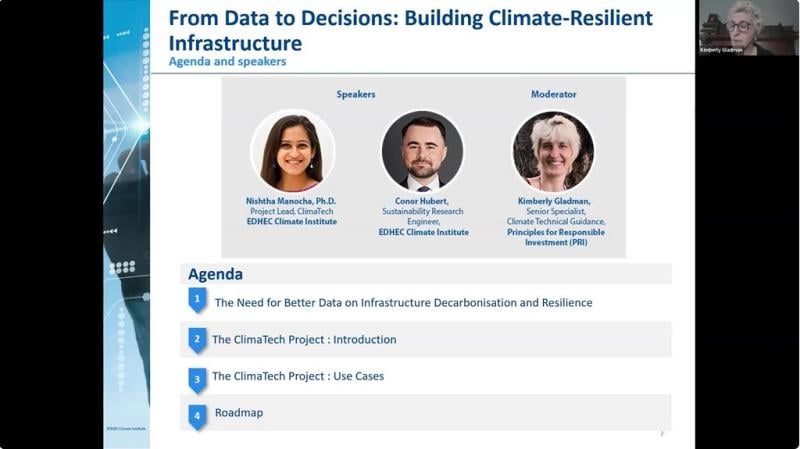
The webinar “What Really Works for Infrastructure Resilience and Decarbonisation: Inside Climate Tech’s Global Framework of Climate Solutions” presented the Climate Tech project, a major research initiative of the EDHEC Climate Institute developed in partnership with Scientific Climate Ratings. Hosted in collaboration with the Principles for Responsible Investment (PRI), the session gathered over 450 professionals from more than 50 countries, underlining the growing interest in robust, data-driven approaches to climate risk and infrastructure investing.
Dr. Nishta Manocha, Project Lead for Climate Tech at the EDHEC Climate Institute, opened by situating the project within the Institute’s broader mission: advancing applied research at the intersection of climate and finance to support better measurement and management of climate-related financial risks. The Institute brings together a multidisciplinary team across France, the UK and Singapore, with around 60% of researchers holding PhDs. Its work focuses on helping investors understand the financial impacts of climate change – both transition risk (linked to decarbonisation policies and market shifts) and physical risk (linked to extreme events and chronic climate change).
Drawing on earlier EDHEC research, Manocha highlighted that transition risks alone could translate into around USD 600 billion in potential losses for the infrastructure asset class between now and 2050. At the same time, physical risks such as floods, storms, heatwaves, droughts or sea-level rise could wipe out up to 54% of portfolio value in extreme scenarios. These figures are not presented as remote hypotheticals but as material threats to investors’ balance sheets. Survey results from more than 200 infrastructure investors and asset managers reinforced this picture: 97% of respondents recognised physical and transition risks as real and significant, and about two thirds expected them to have a meaningful impact on their investments. Respondents also consistently pointed to a need for better non-financial data, not only for risk management but also for regulatory reporting, stakeholder communication and identification of new opportunities.
To illustrate real-world exposure, Nishtha presented results from Scientific Climate Ratings, an EDHEC venture that tracks over 6,000 infrastructure assets across 101 infrastructure subclasses worldwide. The system evaluates both transition and physical risks for each asset, applying eight climate scenarios to project asset value changes out to 2030 and 2050. This enables a granular view by sector and geography of where climate risks are concentrated and how they might translate into financial losses. For example, within low-exposure assets (rated A–B on a scale from A to G), 95% are renewable power assets, whereas the high-exposure group (E–G) is dominated by transport, conventional power and other carbon-intensive or hazard-sensitive sectors. Further breakdowns show that renewable assets, while relatively shielded from transition risk, remain significantly exposed to physical risks, whereas conventional power and transport tend to be highly exposed to both.
By combining exposure ratings with expected damages to 2035, the analysis shows that the worst 18% of assets (those rated F and G for physical risk) account for about 50% of expected financial damages, underscoring the disproportionate impact of the most vulnerable assets. This evidence supports a core message of the webinar: not all infrastructure is equally at risk, and investors need detailed, asset-specific insights to prioritise where and how to act.
The central question then becomes: what can asset owners and managers actually do to decarbonise and build resilience, and how can they compare options in a robust and consistent way? According to EDHEC’s survey, only 16% of investors felt that current knowledge on climate resilience was sufficient to measure the impact of infrastructure investments in a meaningful way. Investors know they must act, but face uncertainty about which strategies to use, how effective they are, and at what cost.
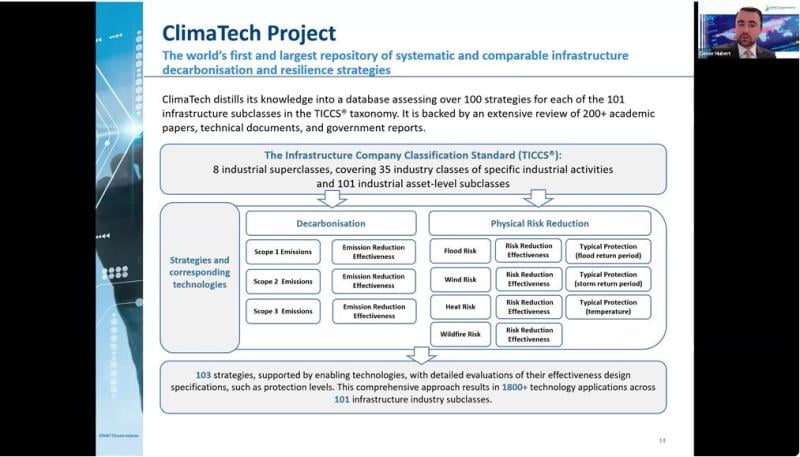
This is the gap the Climate Tech project aims to address. As Conor Huber, Sustainability Research Engineer at EDHEC Climate Institute, explained, Climate Tech is a systematic repository of decarbonisation and resilience strategies for infrastructure assets. Built on the TICCS taxonomy, it covers eight infrastructure “superclasses” (non-renewable power, environmental services, social infrastructure, energy and water resources, data infrastructure, transport, renewable power and network utilities), broken down into 35 classes and 101 subclasses. For each subclass, the database identifies the most material strategies for:
-
Decarbonisation (including scopes 1, 2 and 3), and
-
Resilience to four key physical hazards: floods, storms, extreme heat and wildfires.
In total, the database currently maps around 103 strategies in over 1,800 asset–strategy combinations, supported by an extensive review of scientific and technical literature. For each strategy, Climate Tech provides:
-
A clear description and relevant technologies;
-
An effectiveness assessment (e.g., the extent to which a strategy can reduce certain emissions or risk metrics);
-
For physical risk, typical design standards or hazard intensities the measure is expected to withstand.
Conor illustrated how this enables both macro-level and asset-level analysis. At the macro level, strategies can be plotted by frequency of use across the database versus their maximum effectiveness, revealing clusters of:
-
High-impact, widely applicable strategies (e.g., electrification of transport, deployment of renewable generation, operational optimisation);
-
High-impact but niche strategies, critical for specific asset types (e.g., leakage reduction in gas pipelines, biogas capture for certain waste and wastewater assets);
-
Medium-impact but broadly applicable strategies, attractive from an operational cost perspective;
-
Low-impact, low-frequency measures, still important for asset types with fewer high-impact options (such as some social infrastructure).
This approach helps cut through the noise of generic sustainability language, focusing attention on the measures that truly move the needle for each asset type, as opposed to symbolic but low-impact actions. At asset level, the database allows users to filter by asset type and risk to compare which strategies are available, how effective they are, and how they differ across sectors.
The ClimatTech database and a suite of sector-specific research papers (one per superclass, plus an overview paper) are freely available on the EDHEC Climate Institute website. The papers provide additional layers of analysis, including the interaction between strategy effectiveness and typical emissions profiles, enabling assessments of decarboniqation potential by asset class and scope, as well as detailed discussion of design levels for physical protection.
The database already feeds into the Scientific Climate Ratings methodology, for example by adjusting an asset’s physical risk rating based on documented implementation of specific resilience measures.
Looking ahead, the team outlined three main development directions for Climate Tech:
-
Mapping to the EU Taxonomy, to understand how infrastructure asset types and strategies align with taxonomy activities and eligibility criteria;
-
Integrating cost data, to enable cost-effectiveness analysis and support investment decision-making;
-
Expanding beyond infrastructure, initially to the corporate sector and later potentially to real estate and manufacturing.
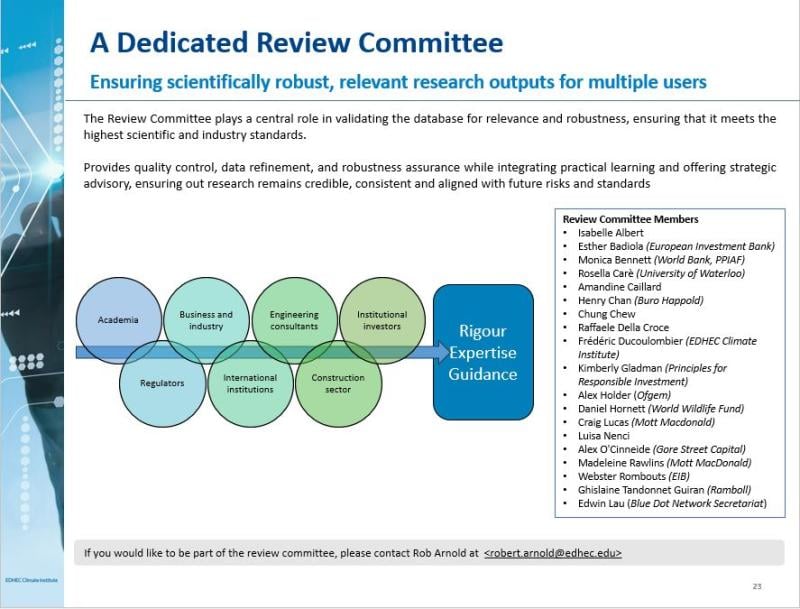
Throughout the webinar, the presenters emphasised that collaboration and continuous improvement lie at the heart of the project. All papers are undergoing review by a multidisciplinary committee of experts from academia, finance, engineering and multilateral organisations. EDHEC invites practitioners and researchers to contribute by reviewing papers, providing data, and sharing real-world case studies of decarbonisation and resilience projects.
In summary, the Climate Tech project offers investors, asset owners, regulators and analysts a rigorous, transparent and open knowledge base to understand what really works for infrastructure decarbonisation and resilience, and to support more informed, climate-aligned capital allocation across the global infrastructure asset class.
Replay available here
Contact us at [email protected] to receive the slides