Scientific Climate Ratings unveils Sovereign Climate Risk Ratings at EDHEC Climate Research Conference 2026
Scientific Climate Ratings unveiled its new Sovereign Climate Risk Ratings during an exclusive announcement at the EDHEC Climate Research Conference 2026, organised by the EDHEC Climate Institute in London.
The new scientific framework quantifies the future effects of chronic physical climate risk on the GDP of more than 190 countries and over 3,400 subnational regions, addressing what Scientific Climate Ratings describes as a sovereign pricing market blind spot.
Developed from the academic research of the EDHEC Climate Institute and the market expertise of Scientific Climate Ratings, the framework captures, for the first time, the winners and losers in a future global economy where chronic physical climate risk has lasting impacts on Gross Domestic Product (GDP).
The ratings provide economically interpretable, scenario-consistent expected macroeconomic impacts, enabling investors, asset managers and banks to price sovereign climate risk. A key feature of the methodology is its subnational granularity: national GDP impacts are derived from estimates of Gross Regional Product (GRP), allowing it to capture significant regional differences within countries.
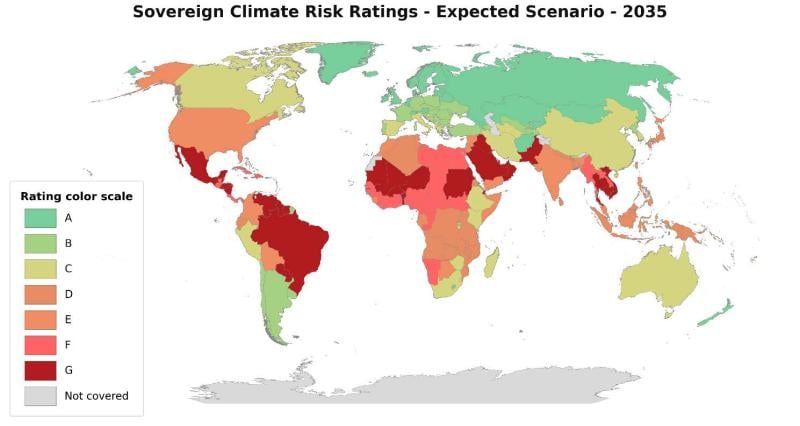
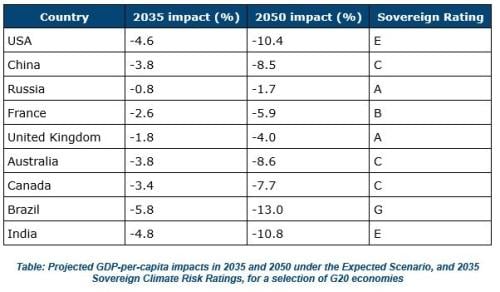
Sovereign Climate Risk Ratings are calculated for two reference horizons, 2035 and 2050, with annual time series also available. Countries receive a letter grade from A to G, with G representing the highest level of exposure.
According to the Expected Scenario, the US receives a sovereign rating of E in 2035, while most of Western Europe ranges from A to C. Much of the African continent is projected to face exposure levels ranging from D to G.
"Climate change is a global phenomenon, but climate risk is local and financial. Our framework captures the structural, compounding output losses caused by chronic warming at the regional level and aggregates them into sovereign-level impacts," said Rémy Estran-Fraioli, PhD, CEO of Scientific Climate Ratings. "It provides the missing transmission channel between climate warming and sovereign fundamentals, identifying structural exposure before spreads fully adjust."
The framework is available across nine forward-looking climate pathways: the seven scenarios published by the Network for Greening the Financial System (NGFS), together with two higher-warming pathways, Climate Breakdown and Climate Destabilisation. It also includes an Expected Scenario derived from the probability-weighted aggregation of these nine pathways, serving as the reference basis for the sovereign rating scale.
"Chronic risks rarely dominate headlines, but increasingly, they are impacting a nation’s gross productivity, thereby reducing growth potential," said Nicolas Schneider, PhD, Senior Research Engineer-Macroeconomist at the EDHEC Climate Institute. "Our framework quantifies this risk as an unconditional expectation that can be added to investors’ financial models. The competitive edge of this rating is the early identification of structural sovereign exposure before it is priced into market spreads."
Sovereign Climate Risk Ratings cover chronic physical risk arising from temperature-driven productivity shifts across 191 countries and more than 3,400 subnational regions, representing more than 95% of global economic output. Scientific Climate Ratings said the framework will continue to evolve through additional quantitative metrics, enhanced granularity and the progressive integration of estimates of expected sovereign spread adjustments.
To learn more about the announcement, read the full press release and discover the EDHEC Climate Research Conference 2026:
• Conference: https://climateinstitute.edhec.edu/events/edhec-climate-research-conference-2026
• Press release: https://scientificratings.com/wp-content/uploads/2026/06/PR_SovereignClimateRiskRatings_June_2026.pdf
• Visit https://scientificratings.com/sovereign-ratings/