Blog
Scientific Climate Ratings Unveils the Sovereign Climate Risk Rating at the EDHEC Climate Research Conference
Reading time
:
2mn

Scientific Climate Ratings Unveils the Sovereign Climate Risk Rating at the EDHEC Climate Research Conference
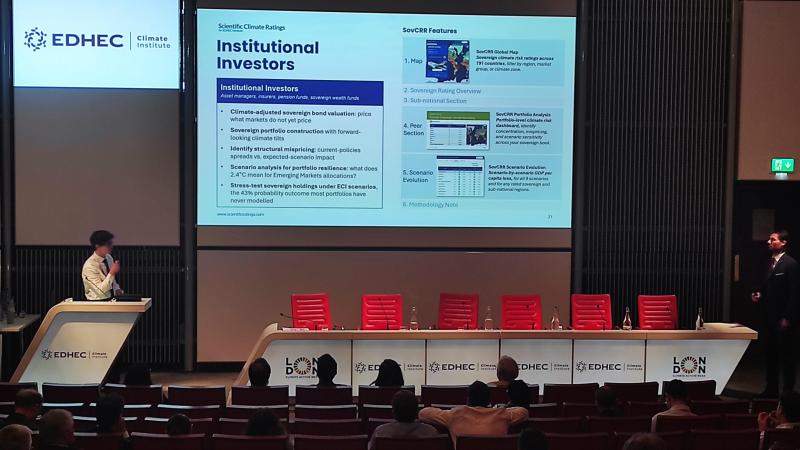
To close the EDHEC Climate Institute's inaugural Climate Research Conference, Alexis de Pampelonne, Climate Risk Manager at Scientific Climate Ratings (an EDHEC Venture), and Nicolas Schneider, Senior Research Engineer at the EDHEC Climate Institute, took to the stage to unveil the Sovereign Climate Risk Rating (SovCRR). This product finally answers the question that stakeholders have been asking: which nations face the highest risk of climate-related economic damages, and how can we price that risk?
Here is a summary of what was covered in the closing session of the conference.
The session explained how markets are reasonably efficient at reacting to acute climate shocks. However, they are yet to price in the gradual productivity losses that accumulate year on year as countries warm.
The presentation argued that this is a structural blind spot rather than a data gap, and existing sovereign climate frameworks have not fully addressed this issue. Some frameworks provide rankings, which are useful for comparison, but do not quantify the extent of loss. NGFS scenarios supply scenario-consistent GDP projections, but these are conditional on a single pathway. Meanwhile, academic damage functions have never been packaged for investors.
The consequence is that unpriced risk is accumulating in portfolios. The institutions that move first to price it properly stand to capture a durable edge as the rest of the market catches up.
The speakers then unveiled the Sovereign Climate Risk Rating as the tool the market needs, moving the conversation from "what if" to "what's likely" to "what's expected".
The SovCRR methodology involves four stages. First, a historical climate-growth response function is estimated across 1,661 regions in 88 countries, identifying a non-linear relationship between local temperature and regional GDP per capita that peaks in productivity around 13°C. Second, this function is projected forward and extended to more than 3,400 sub-national regions across 191 countries. Third, results are translated into the NGFS scenario framework. Finally, outcomes are re-projected across nine climate scenarios, each carrying an explicit probability and aggregated from region to country using population-density weights.
The result is a single economically interpretable metric per country across two horizons (2035 and 2050), which is directly comparable and usable in existing financial models.
The presentation highlighted just some of the many insights uncovered by this granular analysis.
The first is a pronounced latitude gradient: high-latitude regions see limited losses, or even modest gains, while losses increase sharply toward the tropics, once measured at the sub-national level. The second is what the speakers termed ‘aggregation asymmetry’, whereby the impact curve is concave, and gains from warming in cooler regions are consistently smaller than losses from equivalent warming in hotter ones. The third is that scenario outcomes converge in the near term and diverge sharply thereafter, as projections across all nine scenarios sit within a narrow band through 2035, then fan out after 2050.
At the country level, the speakers highlighted the United States as an example of the insights uncovered from sub-national analysis. In theory, the USA sits near the optimum productivity temperature (13°C) with a national average temperature of 12°C. However, this average conceals that more than 40% of US economic activity occurs in the southern states that are well above the 13°C threshold. As such, by 2050 under the expected scenario, the US faces a GDP loss of -10.4% and has been assigned an ‘E’ Sovereign Climate Risk Rating. National averages conceal such insights.
The session closed by sharing how the public sector, banks, and institutional investors can use these numbers to stress-test sovereign exposure, inform capital allocation, and identify where climate risk is currently accumulating unpriced. The Sovereign Climate Risk Rating provides a single rating coupled with decision-useful metrics, closing the distance between what researchers have long known and what markets have yet to price. It is a distance the EDHEC Climate Institute and its ventures have spent years working to close, and this launch marks one of our biggest strides yet.