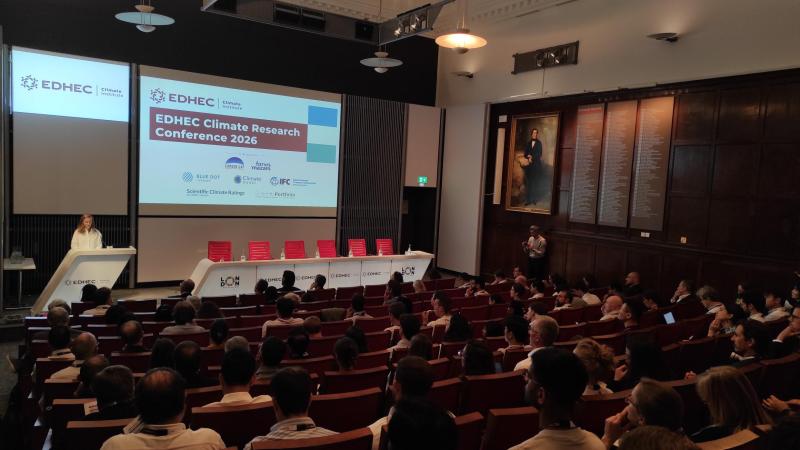
On 23 June 2026, the EDHEC Climate Institute (ECI) hosted its inaugural Climate Research Conference, as part of London Climate Action Week. Under the theme Climate Risk and Business Resilience: From Science to Strategic Action, the event brought together researchers, investors, and policymakers to confront a central challenge: how to move beyond recognising climate risks and begin measuring, pricing, and managing them with scientific rigour. RTL Today broadcaster Lisa Burke masterfully steered the room through a full day of discussions spanning climate scenarios, hyperlocal damage modelling, transition risk, resilience technologies, and an exclusive product announcement.
"The question is no longer whether climate change will affect our economies and financial systems, but how its impacts will unfold, where they will be felt most acutely, and how institutions can respond effectively" Emmanuel Metais, Dean of EDHEC Business School
The EDHEC Climate Institute's Director Camille Angué reinforced this point in her opening address. "Climate change is becoming a material economic reality," she told attendees. "Yet our tools for measuring, pricing, and managing its consequences remain imperfect. Today is about closing that gap."
Together, the day’s sessions underscored a shared conviction: that financial resilience to climate change depends on rigour, granularity, and a willingness to confront uncertainty head-on, rather than retreat from it.
Step One: Establishing a Full Set of Climate Scenarios
The sessions opened with EDHEC Business School Professor Riccardo Rebonato’s overview of climate scenarios, which he called an “incredibly dynamic field” and “one of the most rapidly evolving areas of climate research”. However, while there is a wealth of information on warming projections, he also shared that these scenarios are of the most value to stakeholders when they are comprehensive and assigned probabilities. That’s precisely the aim of the ECI’s dedicated climate scenarios team.
Lionel Melin, Associate Researcher at the ECI, presented the Institute's work on assigning explicit probabilities to climate trajectories and expanding the scope of the established NGFS frameworks to include two additional high-emission pathways: Climate Destabilised and Climate Breakdown. This work ensures that decision-makers can assess a full range of potential outcomes and future-proof their strategies even in worst-case scenarios.
From Temperature to Economic Damages: Why Granularity Matters
The conference then examined how these very climate scenarios may translate into macroeconomic damages, and why granularity is key for decision-makers.
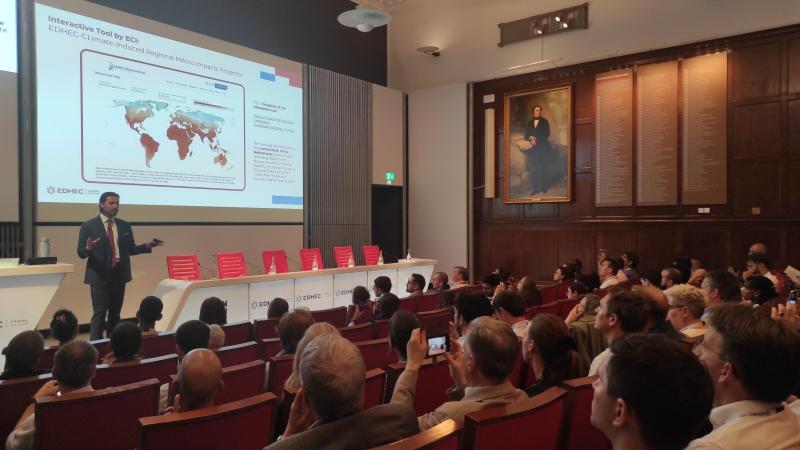
Nicolas Schneider, Senior Research Engineer-Macroeconomist at the ECI, showed how advances in climate science, geospatial modelling, and satellite data are enabling increasingly precise assessments of physical climate risk. Specifically, he shared how ECI research has shown that sector- and region-specific damage trajectories are largely heterogeneous. Decomposing impacts across time, space, and sectors gives stakeholders a fundamentally more useful and actionable picture than aggregated figures.
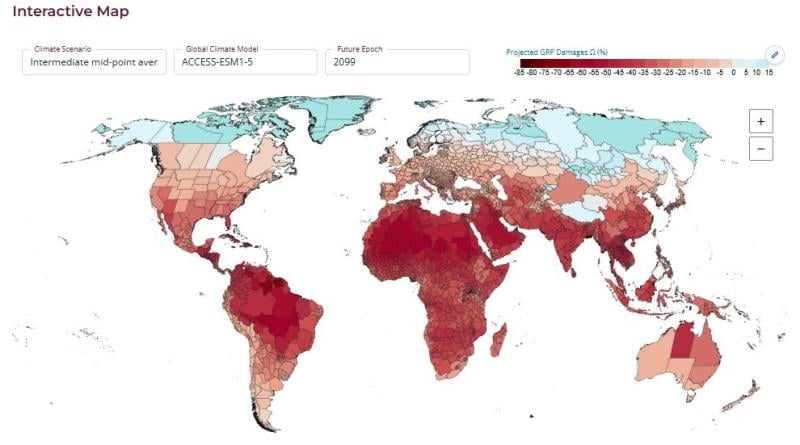
This work is operationalised through CLIRMAP, ECI's proprietary tool mapping the relationship between temperature and regional economic decline. This platform combines economic modelling and granular geospatial data to visualise how climate change–induced shifts in average temperature are projected to affect gross regional economic product under various climate scenarios, models, and epochs.
Representatives from Forvis Mazars then took to the stage to discuss how they themselves use granular data to determine the climate exposure of assets in the agriculture sector. The speakers presented their climate risk toolkit for stakeholders across crop and livestock sectors, corroborating the ECI’s findings that individual assets face starkly different risk profiles, even if they appear similar on the surface.
“Future macroeconomic damages are expected to vary at least as much over time and space as they do across sectors” Nicolas Schneider, Senior Research Engineer-Macroeconomist at the EDHEC Climate Institute
Quantifying the benefits of action against the cost of inaction using the ClimaTech database
Having established that individual assets face variable climate risk, Thibaud Barnaud of Scientific Climate Ratings, an EDHEC Venture and Oxana Megglé, Senior Investment Officer at the IFC (World Bank), showed how targeted investments in resilience strategies can deliver returns in the long run. Scientific Climate Ratings, the IFC, and AXA Climate together conducted cost-benefit analyses of climate mitigation measures on three assets in Brazil, one of which operated in the energy transmission and distribution sector, another was a water and sanitation asset, and the other was a road. The report found that such measures delivered significant returns on investment in the form of improved net asset value; in the case of the transmission and distribution asset, every $1 invested in adaptation and resilience saw $8.6 of asset value protected.
But how can asset owners and managers identify which measures could deliver such returns on investment for their assets?
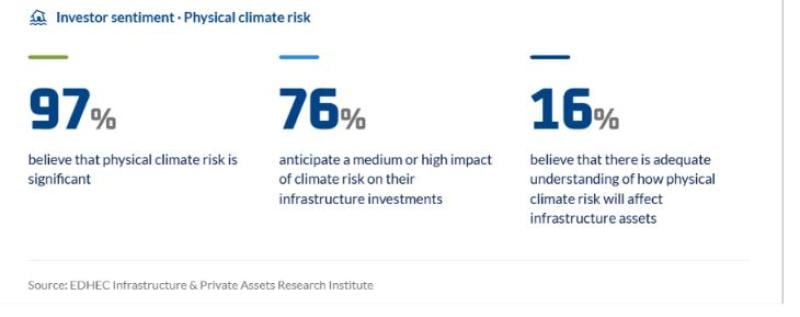
A recurring theme of the conference was the gap between climate risk awareness and the ability to act on it. A poll of investors conducted by the EDHEC Infrastructure & Private Assets Research Institute found a striking disconnect: most stakeholders recognised the risks, but few felt they had the tools to respond.
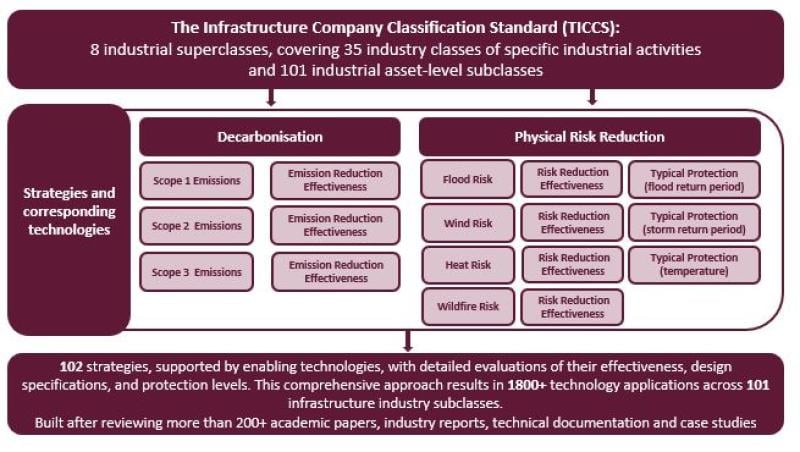
The ClimaTech initiative, which project lead Nishtha Manocha presented to the conference, directly addresses this gap. ClimaTech is a structured database of over 1,800 resilience and decarbonisation measures, drawing on engineering literature, policy databases, and real-world project data. The framework allows practitioners to move from climate risk identification to practical implementation, narrowing broad strategy sets into asset-specific recommendations, and linking those recommendations to measurable reductions in physical and transition risk.
The conference showcased a real-world example of the practical applications of the ClimaTech database in the case of the Angololo Water Resources Development Project, which includes a dam, mini hydropower plant, and irrigation network. The presentation highlighted how ECI research and products produced by its Scientific Climate Ratings venture were used to assess physical climate risk, identify resilience measures, and complement the project's Blue Dot Network certification.
Transition Risk is More Than Carbon Pricing
The afternoon sessions turned to transition risk.
Paula DiPerna, author and strategic advisor, opened with an overview of the history of the carbon market, before Michael Azlen, Founder and CEO of Carbon Cap Management, took to the stage to discuss how this market may mature in the coming years.
Anthony Schrapffer, Scientific Director at the ECI, then broadened the frame. Transition risk, he argued, is routinely underestimated when it is reduced to carbon prices and direct emissions. In reality, infrastructure assets and companies face exposure to policy volatility, technological disruption, shifting consumer preferences, geopolitical developments, and Scope 3 supply-chain transformations. The ECI's multi-factor transition risk framework, which incorporates these channels in a forward-looking, sector- and geography-specific model, lays the groundwork for more robust, science-based assessments of transition exposure across diverse regulatory and market scenarios.
Unveiling the Sovereign Climate Risk Rating
To close the conference, Alexis de Pampelonne, Climate Risk Manager at Scientific Climate Ratings, and Nicolas Schneider unveiled a landmark new product: the Sovereign Climate Risk Rating (SovCRR).
The SovCRR is a scientific framework for understanding and pricing the macroeconomic impact of rising temperatures on sovereign economies. Built on the ECI's climate finance research, it captures how chronic physical climate risk is expected to affect gross domestic product across 191 countries. This product offers invaluable insights into which economies stand to gain or lose in a warmer world, and how quickly those divergences may materialise.
“We packaged the science and extended the scenarios to deliver the quantified impact markets were missing” Alexis de Pampelonne, Climate Risk Manager at Scientific Climate Ratings
Bridging the Gap Between Climate Science and Financial Decisions
The conference converged on a message that will only grow in urgency: climate risk is a present-day financial reality that must be measured, priced, and managed. However, many stakeholders are yet to act on this fact. Investors are still allocating capital without fully pricing physical risk. Infrastructure asset owners are making long-term operational decisions without factoring in scenario-tested adaptation plans. Policymakers are designing frameworks without the granular inputs needed to make them truly applicable and effective.
The inaugural EDHEC Climate Research Conference demonstrated what becomes possible when rigorous applied research engages directly with the demands of such decision-makers. Closing the gap between awareness and action requires more than just climate research; stakeholders need actionable insights and decision-grade tools, built on scientific foundations. That is the work the EDHEC Climate Institute is built to do, and the conference showed that this work is already well underway.