Industry Trends & Analysis
Protection, adaptation, evaluation
Reading time
:
5mn
By Alice James, Content Editor, EDHEC Climate Institute

Protection, adaptation, evaluation
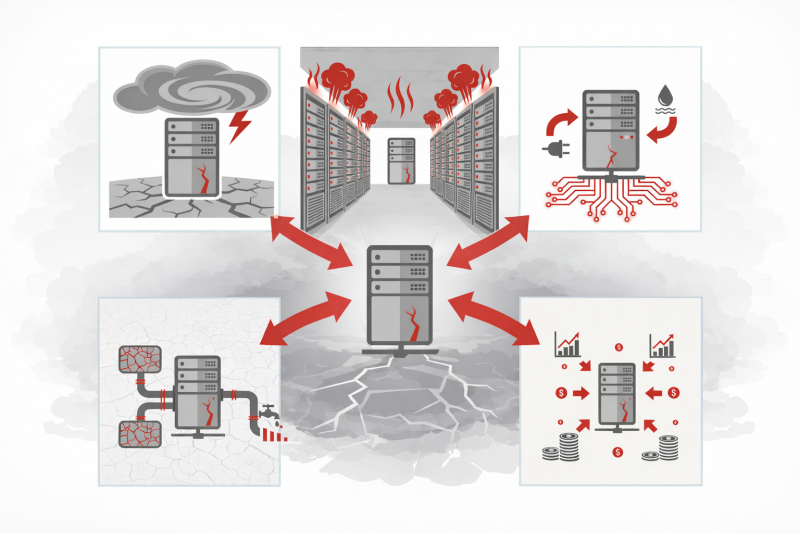
Our ClimaTech research project provides investors with a wealth of data to assess the climate risks to this sector and the wider global infrastructure universe.
In this note, we take a look at the climate threats imperilling data infrastructure assets, and how our tools can shed light on how to quantify these[1]. Investors have to consider many kinds of risk exposure when making portfolio decisions, and today one of the considerations at the top of their agenda is climate risk. Historically, this had been hard to quantify, and our research aims to bridge that gap, merging cutting edge research with rigorous academic analysis to produce financial insights[2].
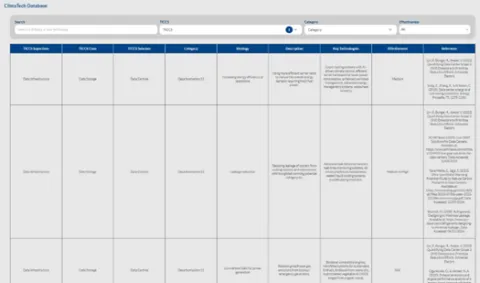
Our ambitious ClimaTech project presents a comprehensive matrix intended to offer stakeholders throughout the infrastructure value chain valuable insights into climate-related risks. We evaluate the effectiveness of transition and resilience strategies for the sector. Additionally, our ClimaTech database is a comprehensive tool that combines a structured classification of infrastructure assets with rigorous, evidence-based assessments. It’s the largest global repository of decarbonisation and resilience measures tailored for infrastructure and includes a listing of the most effective strategies and technologies, accompanied by expert analysis and quantified indicators (see Figure 1).
The data infrastructure sector is uniquely vulnerable, something that we highlight in our ClimaTech risk assessments, given its needs for an uninterrupted and massive supply of electricity, constant need for water for cooling, and its interdependency on other aspects of vulnerable infrastructure.
Figure 1. A screenshot of the ClimaTech Database
Climate change brings a raft of physical risks to the data infrastructure sector, (cell towers, long‑distance cables, satellites, radio/media towers, and data centres). The most material are extreme heat and wildfires, followed by floods and storms, with risk levels varying strongly by geography and site location[3]. Any one of these can directly trigger outages and costly downtime but they also threaten the connectivity, power and water systems that data centres rely on, exposing them to climate-change-driven events happening entirely remotely from their own location[4].
Our research estimates that, under severe “hot house” scenarios without adaptation, extreme weather‑related physical risk can reach around 54% of asset value at the portfolio level, making protection of data infrastructure economically critical. Without proactive resilience measures, data infrastructure owners face the prospect of substantial value erosion from more frequent and severe climate‑driven events, despite some inherent resilience built into current design standards.
It’s remarkable how much variation in temperature and humidity people can casually tolerate, certainly for short periods of time. UK guidelines for office temperatures are as broad as 16-30°C[5], and even down to 13°C in locations where physical exertion is required. Automated facilities have even more impressive tolerances; industrial robots can operate in ambient temperatures ranging from -29°C during winters to over 38°C in summer[6].
Not so the cutting-edge electronics required to store and process exabytes (billions of gigabytes) that hyperscale centres are required to cope with. Indeed, data centres have the strictest and most precise environmental requirements. The acceptable operating temperature range is narrow – just 18-27°C, according to the American Society of Heating, Refrigerating and Air-Conditioning Engineers[7], widely considered the gold standard for data centre heat guidelines.
The contrast is striking: offices have basic comfort requirements with a practical range of up to 17°C practical range and robot warehouses can operate across a 68°C+ range with minimal environmental controls. Data centres, meanwhile, sit in the opposite tail; they require precision control within a 9-12°C temperature range. (It’s worth noting that they also have strict humidity bands and require clean filtered air.)
That means even small variations in ambient temperature can have catastrophic results – quite the Achilles heel in a world experiencing extreme heat events of growing frequency and duration.
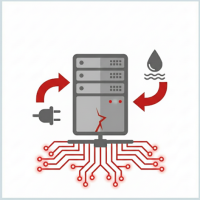
Extreme weather and wildfires are leading drivers of grid outages, so more severe storms, heatwaves and floods raise the threat of power loss to data centres and network nodes, stressing short‑duration backup systems[8].
Data infrastructure depends on external water, transport and energy networks that are themselves exposed to climate hazards, so failures in these supporting systems can cause cascading outages even if the core facilities themselves have been well protected[9]
Physical damage, access disruption, and power or cooling loss can lead to prolonged service outages, latency spikes and reduced capacity[10]. Over time, higher hazard intensity and frequency are likely to increase insurance costs, CapEx for climate adaptation, and OpEx for energy and water usage. Some analysis has forecast multi‑trillion‑dollar additional running costs for existing data-centre fleets under high‑heat scenarios[11].
Transition risks from climate change expose data infrastructure to regulatory, market, technological and reputational pressures that can significantly alter asset values, cost structures and business models. These risks arise not from the physical climate itself, but from the global shift to a low‑carbon and climate‑resilient economy. Our research signals plausible asset value losses of up to around 30% if emissions are not reduced.
Because data infrastructure emissions are expected to grow with rapid sector expansion, the sector’s transition risk will increase unless emissions are cut in line with tightening climate policy and investor expectations (see Figure 2).
Figure 2: Global Data Infrastructure CO2 Emissions Breakdown
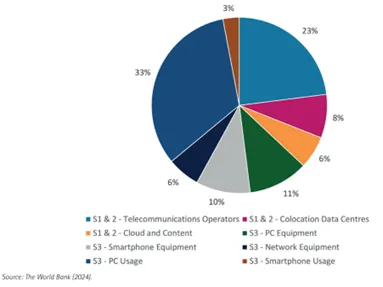
Source: The World Bank (2024), https://climateinstitute.edhec.edu/system/files/publications/ECI_ClimaTech_Data_Infrastructure_IC50_3.pdf, page 20.
Rapid advances in energy‑efficient hardware, cooling, and software optimisation risk making older, less efficient data centres commercially obsolete or “stranded” as clients and regulators favour low‑carbon, high‑efficiency platforms[12]. While that’s good for the environment operationally, it has high up-front embodied carbon costs and is yet another climate risk investors need to bear in mind when assessing asset vulnerability.
Global data infrastructure currently accounts for about 1.5–4% of global greenhouse gas emissions, with emissions concentrated in electricity use (Scope 2). Infrastructure assets which cannot limit emissions to legislated levels may face penalties, operating restrictions or premature decommissioning, with associated risks of asset devaluation and stranding[13].
A failure to decarbonise can raise insurance and financing costs and reduce attractiveness to investors, as climate policy frameworks (such as taxonomy criteria) increasingly influence capital allocation to infrastructure (see Figure 3)[14].
Figure 3: Evolution of the carbon tax for the various scenarios in the Oxford Economics model, expressed as a fraction of the same-time GDP.
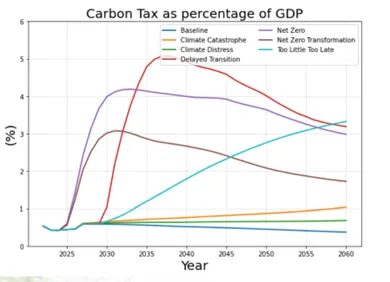
Source: https://publishing.scientificratings.com/sitepublicmethodologies/climate_scenario_probabilities_methodology.pdf , page 12.
That’s particularly challenging for data centres, given their massive energy requirements. Rising electricity demand from digitalisation and “artificial intelligence”, or AI, is under scrutiny, with some analyses suggesting substantial increases in data‑centre energy use that could trigger stricter caps, higher tariffs or carbon‑related charges on intensive users.
Their cooling requirements also give them a unique climate-risk profile given their need for another resource that’s becoming even more precious in a hotter, drier world: water.
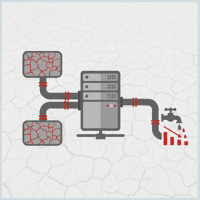
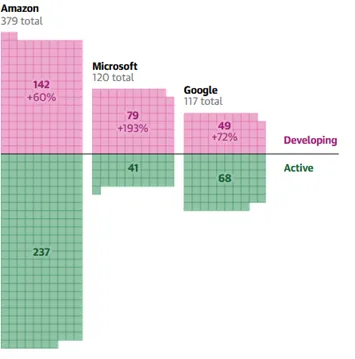
There’s been a wealth of bad press about the amount of water that new data centres are drawing to cool their operations, particularly those needed to fuel the demand for AI processing power[15]. A recent UK report noted a fourfold rise in data‑centre water use since 2021[16]. That’s only going to grow: the Guardian reported that the largest tech companies are preparing to almost double their data centre assets as demand surges (see Figure 4).
Figure 4: Tech giants' datacentres to expand by a combined 78%
Source: The Guardian newspaper.
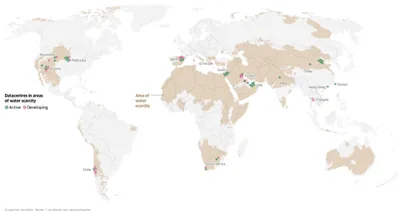
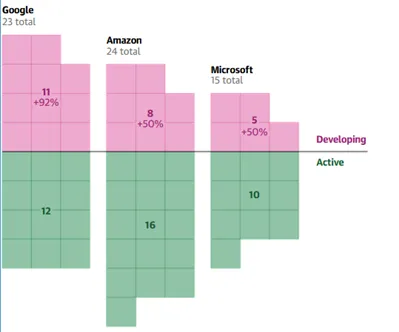
Concerningly, due to selecting areas where it’s cost effective to develop this new infrastructure, many of those are being constructed in regions where water scarcity is already a concern, and likely to be a much greater one in the warmer world of the future (see Figures 5 and 6).
Figure 5: Datacentres in areas of water scarcity
Source: The Guardian newspaper.
Figure 6: Datacentres in areas of water scarcity to increase by a combined 63%
Source: The Guardian newspaper.
Large facilities already consume vast volumes of water in many regions that are moving into chronic water stress. Estimates are that a 1 megawatt (MW) data centre can use up to around 25.5 million litres of water per year just for cooling, while a 100 MW hyperscale site can consume on the order of 2.5 billion litres annually, putting operators in direct competition with households, industry and agriculture in areas where droughts are intensifying.
Climate change is projected to make those locations hotter and drier, amplifying both physical scarcity and political pressure over how water is allocated. As scarcity deepens, data centres face higher raw water prices, the need to invest in more advanced treatment and recycling, and the financial risk of enforced curtailment or shutdowns during drought emergencies[17].
In water‑stressed regions, local authorities and communities are already challenging new data centre developments on the grounds that they could worsen drinking‑water shortages and agricultural losses, and responses are likely to include tighter abstraction limits, higher tariffs, stricter permitting and requirements for “water‑positive” or recycled‑water operation, all of which add to costs.
Firms relying on water‑intensive data centres in drought‑prone or climate‑vulnerable areas face material financial risks from rising water costs, regulatory restrictions and reputational damage as climate change drives a structural increase in the scarcity value of water.
In our ClimaTech focus on the sector, we look at opportunities for data centre assets to reduce their climate transition impacts. Several of the most material decarbonisation and physical‑risk strategies also reduce the need for water by cutting overall cooling demand. These include switching to natural and evaporative cooling, optimising operational practices (such as safely raising operating temperatures and improving layouts), and locating new centres in cooler climates[18].
These measures lower energy use and emissions from cooling but also reduce reliance on resource‑intensive mechanical systems. This enables them to mitigate transition risk, improve resilience to extreme heat, and ease pressure on local water supplies. The latter also supports wildfire response capacity in stressed regions.
In summary: climate change is putting challenges on the data infrastructure sector in the form of direct impacts such as extreme heat, flooding, power outages, wildfires etc, and the costs and challenged of adapting to protect themselves against these risks. There are also stranding risks when assets cannot comply with legislation to become greener. The ClimaTech project demonstrates to investors what strategies work to reduce these risks to their assets.
This sector is particularly vulnerable given its needs for an uninterrupted and massive supply of electricity, constant need for water, and interdependency on other aspects of vulnerable infrastructure.
Scientific Climate Ratings is working to improve the tools available to investors to gauge the risks climate change is bringing to these assets.
References
[1] See https://scientificratings.com/data-and-analytics/#climatech for our project to capture the physical and transition risks delivered by climate change that investors need to be aware of.
[2] For our in-depth analysis of the climate risks facing the data infrastructure sector, see: https://climateinstitute.edhec.edu/system/files/publications/ECI_ClimaTech_Data_Infrastructure_IC50_3.pdf
[3] See https://xdi.systems/news/global-data-centres-face-rising-climate-risks-xdi-report-warns-landmark-analysis-of-nearly-9000-sites-reveals-escalating-threat-to-digital-infrastructure and https://www.ramboll.com/en-us/insights/resilient-societies-and-liveability/climate-risks-in-data-center-infrastructure
[4] See https://www.datacenterdynamics.com/en/news/climate-threats-to-data-centers-set-to-surge-report/ and https://bindinghook.com/unpacking-the-vicious-cycle-of-climate-change-and-digital-security/
[5] See https://www.hse.gov.uk/temperature/employer/the-law.htm, https://praxis42.com/resources/health-and-safety/what-is-the-legal-working-temperature-in-the-uk/, and https://health-safety.ed.ac.uk/guidance/work-environment/temperatures
[7] Available here: https://xp20.ashrae.org/datacom1_4th/ReferenceCard.pdf
[8] See https://www.weforum.org/stories/2025/10/data-centres-3-3-trillion-question-heat-cooling/ and https://hexatronicdatacenter.com/en/knowledge/how-are-data-centers-affected-by-extreme-weather
[10] See https://www.itu.int/en/mediacentre/backgrounders/Pages/climate-change.aspx and https://devops.com/data-at-risk-navigating-the-impact-of-climate-change-and-extreme-weather-on-data-centers/
[11]See https://www.ukclimaterisk.org/wp-content/uploads/2021/06/CCRA3-Briefing-Telecoms-and-ICT.pdf and https://airsysnorthamerica.com/the-impact-of-climate-change-on-a-telecom-cooling-system/
[12] See https://netzeroaction.org/resource/manage-energy-in-data-centers/ and https://about.bnef.com/insights/clean-energy/power-hungry-data-centers-are-driving-green-energy-demand/
[13] See https://publishing.scientificratings.com/sitepublicmethodologies/climate_scenario_probabilities_methodology.pdf
[15] See https://www.theguardian.com/environment/2025/apr/09/big-tech-datacentres-water and https://www.cloudcomputing-news.net/news/data-centre-water-consumption-crisis/
[17] See Cloud Computing News on data centre water consumption and cooling methods: https://www.cloudcomputing-news.net/news/data-centre-water-consumption-crisis/, IEM on the hidden water footprint of data: https://www.iemplc.co.uk/news/addressing-the-hidden-water-footprint-of-data/, Veolia Water Technologies on cooling tower water losses: https://blog.veoliawatertechnologies.co.uk/data-centres-and-water-what-you-need-to-know, and TechUK on data centre water use and climate‑driven water stress in England: https://www.techuk.org/resource/guest-blog-balancing-bytes-and-drops-understanding-data-centre-water-use-in-england.html
[18] See our focus on the sector here, https://climateinstitute.edhec.edu/system/files/publications/ECI_ClimaTech_Data_Infrastructure_IC50_3.pdf, Section 3, especially Subsections 3.2 and Table 3, and Section 4 details on Natural Cooling and Optimise Operational Practices.