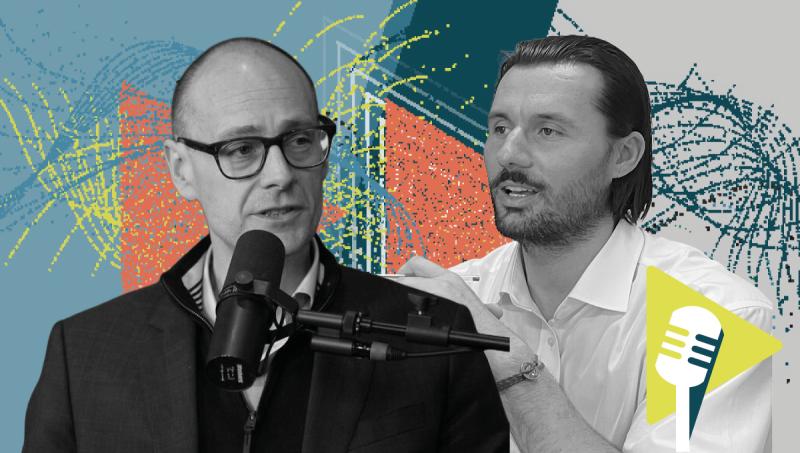
During London Climate Action Week, Nicolas Schneider, Senior Research Engineer and Macroeconomist at EDHEC Climate Institute, joined Toby Mitchenall, Senior Editor at PEI Group and Editor of New Private Markets, for an in-depth conversation on a question that is becoming increasingly important for institutional investors: how can physical climate risk be translated into economic and financial materiality?
The conversation builds on an earlier exchange between EDHEC Climate Institute and New Private Markets. Earlier this year, Toby Mitchenall moderated an EDHEC Climate Institute webinar introducing EDHEC-CLIRMAP (EDHEC-CLimate-Induced Regional MAcroimpacts Projector) and exploring the research and methodologies behind the tool. Their discussion during London Climate Action Week provided an opportunity to take the conversation further, from modelling regional economic impacts to understanding what physical climate risk means for asset valuation and portfolio construction.
In this episode of The New Private Markets Podcast, Nicolas Schneider discusses why physical climate risk remains insufficiently reflected in financial valuations and why assessing its materiality requires connecting three dimensions: the occurrence of physical climate risks, their economic consequences across regions and sectors, and ultimately their impact on asset values.
The conversation highlights several key considerations for investors seeking to better understand and integrate physical climate risk into investment analysis.
Physical climate risk is highly heterogeneous
Its economic consequences can vary significantly across geographies, climate scenarios and time horizons. EDHEC-CLIRMAP was developed to help make these differences visible by translating climate projections into estimates of changes in regional economic output.
Climate risk can affect both sides of asset valuation
Physical risks can influence expected cash flows through their impact on economic activity, while also affecting discount rates by changing the future states of the world in which those cash flows are generated.
“You need to translate the physical risk occurrence to the economic implication, to the financial implication.”
— Nicolas Schneider
Acute events are only part of the picture
“It’s not a matter of how, it’s a matter of when. Climate change is shifting the intensity and frequency of extreme events. All firms have a cost function.”
— Nicolas Schneider
Floods, wildfires and other acute events are the most visible manifestations of physical climate risk. But chronic changes, including rising average temperatures, shifting precipitation regimes and sea-level rise, can continuously affect productivity and compound over time, potentially altering the long-term economic trajectory of countries.
The potential economic consequences are substantial. Nicolas Schneider points to academic studies published in 2015, 2024 and 2026 estimating global GDP losses of approximately 14%, 33% and 45%, respectively, under a 3°C warming scenario. As methodologies evolve to capture more sources of climate variability, physical risk components, sector-specific effects and potential propagation through supply chains, estimates of economic damages have increased.
Scenario probabilities matter
Moving from “what if?” to “what is likely?” and ultimately “what is expected?” requires attaching probabilities to climate scenarios and translating physical impacts into economic and financial outcomes. As explored in the EDHEC Climate Institute study “How to Assign Probabilities to Climate Scenarios”, there is an approximately 40% chance of global temperatures exceeding 3°C by 2100. In the podcast, Nicolas Schneider notes that a 3°C warming outcome is roughly aligned with the NGFS current-policies scenario.
For investors, more climate data is not enough
The challenge is to transform climate information into decision-relevant metrics that can feed into valuation models and portfolio decisions, connecting physical risk occurrence, economic implications and financial materiality.
This approach is central to the EDHEC Climate Institute’s research agenda: bridging climate science, economics and finance to develop transparent, scientifically grounded and decision-relevant tools and methodologies for investors.
Listen to the full conversation: The New Private Markets Podcast — “Going deep on physical climate risk”
Explore the research: Revisit the EDHEC Climate Institute webinar on EDHEC-CLIRMAP, moderated by Toby Mitchenall.