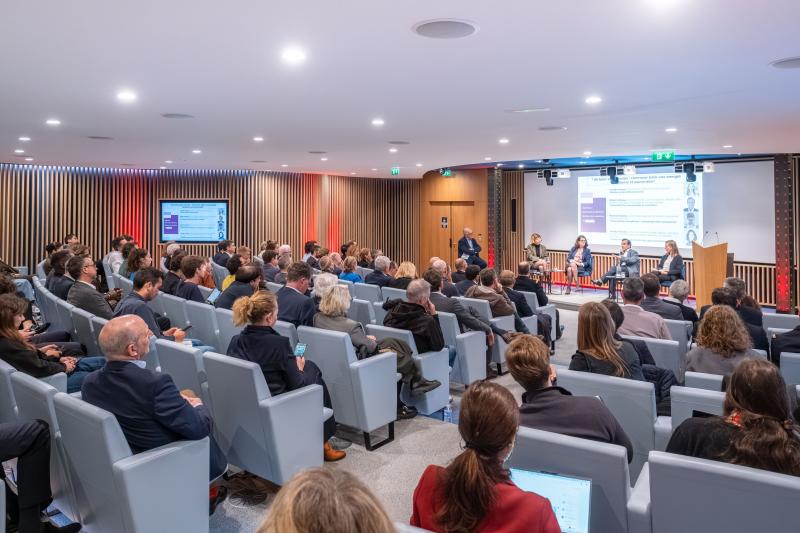
On 19 May 2026, nearly 200 participants gathered at the EDHEC Paris campus for the conference “A New World Order: Businesses in the Energy Battle”. Organised by the EDHEC Business School Chair in Geopolitics and Business Strategy in partnership with the EDHEC Climate Institute and the French Institute of Geopolitics / CASSINI, the event explored the growing challenges of energy sovereignty, critical infrastructure resilience and the interplay between climate and geopolitical risks.
Bringing together experts, researchers, business leaders and institutional stakeholders, the conference provided a forum for discussing the profound transformations reshaping the global energy landscape. In an increasingly uncertain world, energy has become far more than an economic sector: it is now a strategic lever that influences power dynamics, supply chain security, competitiveness and national sovereignty.
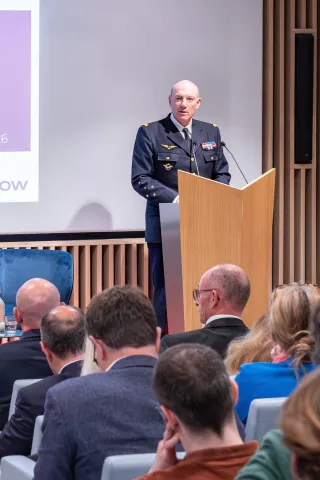
The conference opened with remarks from General Jérôme Bellanger, Chief of Staff of the French Air and Space Force, who highlighted the extent to which energy issues are now closely intertwined with security, sovereignty and geopolitical power.
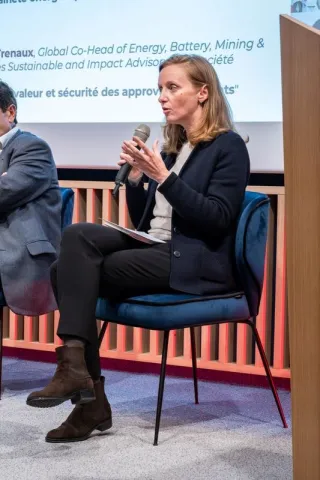
Moderated by Pierre-Henri de Menthon, Editorial Director of Challenges, the panel discussion featured Camille Angué, Director of the EDHEC Climate Institute; Didier Holleaux, former Deputy CEO of Engie and member of the French Academy of Technologies; Noémie Rebière, Associate Researcher at the French Institute of Geopolitics; and Lénaïg Trenaux, Global Co-Head of Energy, Battery, Mining & Industries Sustainable and Impact Advisory at Société Générale.
Discussions focused on several key challenges facing organisations today, including energy security, critical infrastructure resilience, supply chain transformation and the balance between economic competitiveness, energy transition and strategic autonomy.
Climate Change as a Risk Multiplier
During the discussion, Camille Angué stressed that accelerating climate change is no longer solely an environmental issue but also a major source of economic and strategic uncertainty. Climate risks can now act as systemic shocks, compounding other sources of instability, including geopolitical tensions, and creating cascading effects across highly interconnected economies.
In this context, one of the key challenges is to better understand the physical impacts of climate risks and translate them into economic and financial data that can support more informed decision-making by companies, investors and public authorities.
“In a world where climate shocks are becoming more frequent, more intense and increasingly capable of generating global economic consequences, the resilience of critical infrastructure is emerging as a strategic imperative for businesses and public actors alike. Climate is not an isolated risk: it now acts as a multiplier of vulnerabilities, capable of overlapping with other shocks – whether energy-related, financial, technological or geopolitical. The ability to integrate these risks into investment, financing and governance decisions will be a key determinant of resilience, competitiveness and sovereignty in the years ahead.”
The EDHEC Climate Institute also shared research findings highlighting the growing exposure of critical infrastructure to climate risks. Under a high-warming scenario, infrastructure investors could face losses of up to $600 billion by 2050, while the most exposed portfolios could lose more than 50% of their value. Ports, power grids, airports and other strategic assets were designed for the climate conditions of the twentieth century and must now adapt to the realities of the twenty-first.
The Institute also presented its ambition to develop, as part of a public-interest initiative, a rating framework covering 8,000 infrastructure assets worldwide.
Bringing Perspectives Together to Support Decision-Making
The conference further underscored the growing importance of energy sovereignty and supply security. As geopolitical fragmentation increases and risks become more interconnected, organisations are being called upon to strengthen their ability to anticipate disruptions and integrate geopolitical considerations into strategic decision-making.
The event also featured a cartographic session led by David Amsellem, geopolitics expert and co-founder of CASSINI, providing valuable insights into ongoing energy and geopolitical transformations and highlighting the role of mapping in understanding today’s global dynamics.
The conference concluded with remarks from General (Ret.) Luc de Rancourt, Director of the EDHEC Chair in Geopolitics and Business Strategy, who reaffirmed the Chair’s mission: equipping decision-makers with the analytical tools needed to understand a rapidly changing world and act effectively in an environment defined by uncertainty.
Through this event, EDHEC reaffirmed its commitment to bringing together academic, institutional and industry perspectives to shed light on the major strategic challenges shaping the future of businesses and societies.