Global rail networks have already come a long way from their dirty coal-powered past, but our research shows that they still have the potential to improve their climate credentials. They are also highly vulnerable to the physical risks from climate change as tracks traverse vast distances and encounter almost every type of terrain and climate. Fortunately, solutions exist to help reinforce this vital infrastructure.
Our ClimaTech research project identifies the best options for railway infrastructure to adapt to climate change and protect operations and assets, and hence their investors, from these physical and transitional risks.
From coal to clean: rail’s glow-up so far
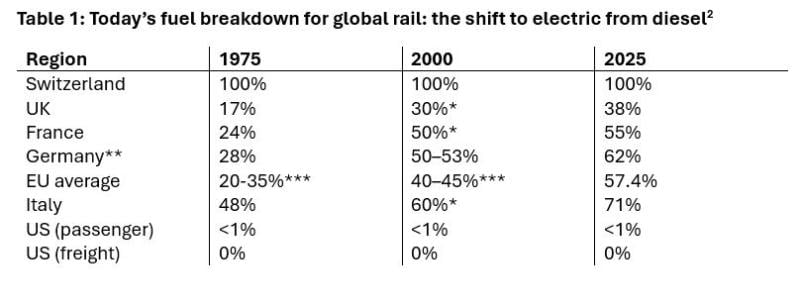
The powering of rail has evolved from the massive iron engines of the early 1800s that burned lumps of coal to today’s diesel, electric, battery and hydrogen trains. At its best, it is now one of the lowest‑carbon ways to move people and freight; at its worst, most trains are still diesel powered. Only around a third of rail globally is currently powered by electricity, though this varies regionally. For example, almost 100% of Swiss rail infrastructure was electrified by 1960; in the US this figure is effectively zero (see Table 1), with almost all networks structurally unchanged over the past half century.
Table 1: Today’s fuel breakdown for global rail: the shift to electric from diesel
Notes: * Our estimate based on interpolated data. ** 1975 Figures are for West Germany, while later figures are for unified Germany. **In 1975, the EU had only six member states; their number would be closer to 35%, while incorporating all current members would be closer to 20%. We have interpolated the figure for 2000 based on 1990 and 2013 data.
The Flying Scotsman: taking the fast track from black to green
Train travel has come a long way already; even diesel is a massive improvement on the (admittedly magnificent) steam engines of the past when it comes to carbon footprints. Today’s fleets of electric, battery and hydrogen trains have helped to ensure that rail is now among the most energy-efficient and low-carbon modes of land transportation.
To take a classic example, the UK’s famous Flying Scotsman, which wends its way from Edinburgh to London, was originally a steam powered locomotive. The carbon footprint efficiencies achieved by its current electric equivalent are astonishing, due largely to the greener power source but also to other technological innovations (see rolling stock improvements below).
Table 2: Estimated CO₂ per person Edinburgh to London
| Transport |
Fuel |
Carbon emissions* |
| Steam train |
Coal |
80 kg CO₂ |
| Modern train |
UK electric grid average |
5 kg CO₂ |
| Modern train |
All wind electricity** |
0.2 kg CO₂ |
| Plane |
Aviation fuel |
90 kg CO₂ |
Notes: *Only accounts for direct fuel emissions, not any other Scope 1, 2 or 3 emissions associated with the railway network.
**Assumes all the electricity to fuel the train came from UK wind power sources.
Sources: https://www.gov.uk/government/publications/greenhouse-gas-reporting-conversion-factors-2023; http://ecopassenger.org; https://www.icao.int/environmental-protection/Carbonoffset/Pages/default.aspx
What is striking is that, even with all the improvements in technology and efficiency pursued by the aviation industry, making the trip by plane today is as expensive in carbon terms as taking the steam powered train would have been over a century ago. Travelling by plane isn’t green.
On track for net zero: decarbonisation of the railway infrastructure
The transport sector accounts for approximately 20% of global GHG emissions. Given this is predominantly from Scope 3 vehicle emissions (33–99% of total emissions depending on the asset), transport infrastructure plays a vital role in global decarbonisation efforts.
Shifting from diesel to electricity is the most significant step that railways can take to reduce their carbon footprint. Where electrification of tracks is challenging, operators can still make significant reductions by switching to greener fuels, such as diesel blended with synthetic or bio fuels.
There is also significant embodied carbon in track, structures and stations, as well as station energy use:
- Scope 1 and 2 for rail operators: Scope 1 includes fuel used by locomotives, on‑site plants and any fossil‑fuelled rail maintenance or service vehicles, while Scope 2 covers electricity for traction power, stations, depots and systems.
- Scope 3 for rail: Scope 3 covers embodied carbon in construction (steel, concrete, track and structures), supply‑chain emissions, and passenger or freight journeys incurred by their use of the rail system.
Transition risks for rail therefore include potential devaluation, for private operators, and regulatory pressure if assets are not aligned with emerging sustainability taxonomies, higher costs under carbon pricing, and competitiveness risks versus lower‑carbon modes or routes.
Effective rail decarbonisation and “greening”
Our research reveals that decarbonisation techniques include:
Laying down solar solutions
Some rail networks have been particularly innovative when it comes to upping their green credentials.
Switzerland’s Sun‑Ways project is trialling a “solar carpet” in Neuchâtel: photovoltaic panels that fit between the lines are laid mechanically by a train that “unrolls” them in a strip so they can later be removed for maintenance. Scaled across Switzerland’s 5,000km of rail network, the scheme could generate an estimated 1TWh annually – around a third of the nation’s public transport electricity needs. The company behind the design is planning similar trials in Spain, Romania and South Korea.
Track‑adjacent panels: Networks across Europe are exploring using embankments and adjacent land for ground‑mounted or elevated solar panels.
Over‑track canopies / roofs: Other proposals include installing solar canopies over stations, platforms or sections of track; these can generate low-carbon power while providing shade and weather protection.
TICCS® – the taxonomy for infrastructure investment
The Infrastructure Company Classification Standard (or TICCS®) defines what asset types count as infrastructure and what sector they fall into.
TICCS® was developed by EDHEC Infra & Private Assets in 2018 and is updated biennially. It classifies infrastructure assets into different industrial activities based on the relevant sector, with eight superclasses, 35 classes and 101 subclasses of asset type. It also includes separate classifications of business risk, geo-economic exposure, and corporate structure, however for this analysis only the industrial activity was the focus. Clear taxonomies help infrastructure investors to understand how sustainable their investments are and could become.
All aboard the green train: decarb of the rolling stock
Vehicles are rarely considered to be core components of global infrastructure assets, but rolling stock is an exception. Within TICCS, rail rolling stock are the only land vehicles to make an appearance; they sit inside the IC60 Transport superclass, and are further divided into “Freight Rail Rolling Stock” and “Passenger Rail Rolling Stock”.
Vehicle and system efficiency
- Rolling stock that draws power from electrified track, either through overhead cables or third rails, will generate 2-4 times less carbon than a diesel train.
- Battery‑electric trains are emerging for partially electrified or regional lines; they can charge from overhead wires or wayside infrastructure and run on stored electricity where wires are absent, avoiding diesel on those sections.
- Hydrogen fuel‑cell trains are being piloted and deployed in parts of Europe and Japan, offering zero tailpipe emissions and potentially low lifecycle emissions when hydrogen is produced using renewable electricity.
- Modern rolling stock is lighter, more aerodynamic and more energy‑efficient, reducing energy use per seat‑km and thus CO₂.
- Regenerative braking on electric multiple units returns energy to the grid or onboard storage, reducing net power demand.
- Higher occupancy (more passengers per train) spreads fixed energy and infrastructure emissions; this is why intercity and urban rail is one of the most carbon-efficient means of transport. Using the train can slash traveller footprint by around 80–90% compared with travelling by car or plane.
On track to protect more than just the railway:
Rail networks traverse vast distances, exposing them to almost every conceivable kind of terrain and weather event. That makes them especially vulnerable to the physical risks of climate change. It also means that they have the potential to have substantial impacts on the locations around tracks and stations – both beneficial and negative. Our research also dives into how the physical protection of the infrastructure and the greening of the network delivers co benefits.
Physical climate risks and mitigation for rail
Railway infrastructure faces significant physical risks from floods, wind, heat and wildfires. However, they can significantly increase resilience through a layered, technology‑led approach that combines structural, nature‑based and operational measures.
- Flooding: Rail lines and associated structures can be washed away or undermined. Flooding can also block lines, causing severe service disruption and compensation costs. Protection methods include elevation of track and critical equipment, as well as structural improvements such as flood barriers and sea walls, drainage upgrades, blue‑green infrastructure, and selective use of pumps.
- Wind: Extreme winds can render rail networks inoperable, for example by blowing debris onto tracks or damaging station structures and street furniture. Mitigations approaches include structural strengthening of buildings and key elements, wind breaks using vegetation, terrain or engineered barriers, and natural infrastructure measures such as habitat restoration and vegetation management.
- Heat: Prolonged or extreme heat can buckle tracks and degrade performance, leading to loss of operating capacity and higher costs. Heat resilience strategies include shading structures, heat‑reflective coatings on exposed surfaces, and heat‑resistant construction materials. There are also benefits from natural and evaporative cooling, blue‑green infrastructure in adjacent corridors, and greening for shading and microclimate benefits.
- Wildfires: Rail lines often traverse areas at high wildfire risk. Tracks can be protected through defensible space management, fuel reduction zones, prescribed burns, vegetation management and landscaping along corridors, and firebreaks. Other tactics include structural hardening of key buildings and equipment, fireproof building materials, and fire suppression systems at critical nodes.
Example: Storm DANA, Spain, October–November 2024
DANA brought over a year's worth of precipitation to eastern Spain in a single day. Adif suspended the Madrid–Valencia high-speed line indefinitely as much of the region's rail infrastructure was submerged, effectively cutting Valencia off from the national rail network. The high-speed line was restored on 14 November after an investment of €16.3 million to repair the Chiva and Torrent tunnels. In Valencia, all five commuter lines were suspended, while some were completely destroyed.
The ClimaTech overview emphasises that many resilience strategies provide co‑benefits: for example, blue‑green infrastructure can reduce both flood and heat risk while improving local amenity and air quality; natural cooling approaches can both protect assets and reduce energy use and emissions.
From Seville to sustainability: the Andalusian rail renaissance
Upgrading tracks to be both greener and safer can yield additional benefits. One clear example can be seen in Spain:
Rebuilding and upgrading the high‑speed rail lines around Andalucía (for example the Antequera–Granada line and Madrid–Seville axis) is expected to bring environmental, social and regional‑development benefits.
- The HSR system as a whole has reduced the annual carbon footprint of the network, as well as delivered reductions in cumulative energy demand, and emissions of both nitrous oxide and non-methane volatile organic compounds.
- The improvements are drawing passengers to rail from road and air, which in turn helps reduce greenhouse‑gas emissions.
- Efficient, electrified operation: HSR has delivered clear air‑quality improvements to its surroundings.
But there are also many other benefits for people and communities, all of which can be impacted by physical climate risk. For example, shorter travel times to supports labour mobility, tourism and business. Andalucía closed 2024 with 451,488 people employed in tourism – an 11.9% increase from 2023 – with the region achieving its lowest unemployment rate in 17 years. Ecosystem Valuation for Railways is exploring ecosystem services like carbon sequestration, flood mitigation, and pollination across railway lands, as well as evaluating the value of mitigation measures like afforestation and wetlands on a section of the ADIF line. As we discuss in detail in the ClimaTech research project, unless addressed, physical risks threaten the wider economy by endangering these benefits.
Conclusion
Rail has gone from early coal‑burning steam to today’s electric, battery and hydrogen trains, and is now one of the lowest‑carbon ways to move people and freight per kilometre travelled.
But it has tremendous potential to deliver further benefits:
Diesel traction still accounts for a significant share of traffic on non‑electrified lines (for example ~20% of rail traffic in Europe and the entire US network are still diesel‑powered), but this share is steadily falling as countries electrify more routes.
Electrification is the main decarbonisation pathway: when grid electricity is low‑carbon (e.g. high shares of renewables or nuclear), emissions per passenger‑km fall to the low tens of grams or even single digits. Biofuels and synthetic fuels can be blended into diesel to reduce lifecycle emissions even where immediate electrification is not feasible.
Our ClimaTech research project provides investors with a comprehensive guide on how railway infrastructure assets can protect their operations and assets from physical transition risks and proactively adapt to the juggernaut of climate change.
Footnotes
- https://climateinstitute.edhec.edu/climatech-project
-
-
-
-
-
-
-
-
-
-
-
-
-
-
-
-
-
-
-
-
-
-
-
-
-
-
-
-
-