Blog
Making Climate Scenarios Decision-Useful: Insights from the EDHEC Climate Research Conference
Reading time
:
2mn

Making Climate Scenarios Decision-Useful: Insights from the EDHEC Climate Research Conference
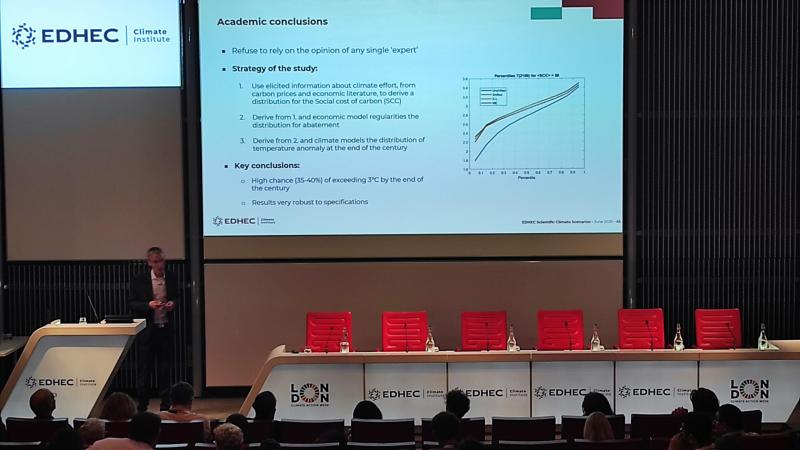
Last month, speakers and attendees from around the world met in London for the inaugural EDHEC Climate Research Conference as part of London Climate Action Week. The timing was pertinent. As Europe sweltered in a heatwave, there was consensus among everyone at the conference that temperatures are rising and climate change is increasingly impacting our day-to-day lives.
However, uncertainty arises from exactly how emissions and climate conditions will develop in the coming years, given the political and environmental unknowns. That’s where climate scenarios come in, and Lionel Melin, Associate Researcher at the EDHEC Climate Institute (ECI), took to the stage to share the advancements the ECI is making in this field.
Here is a summary of what we learnt from his session on 'Assigning Probabilities to Climate Scenarios'.
Climate scenarios represent a range of possible future climate outcomes and are used to assess risks, impacts, and potential economic and financial losses linked to climate change. They are built to capture a wide range of plausible emission trajectories, but on their own they simply tell decision-makers which outcomes are possible, not most likely.
To maximise the value of climate scenarios for decision-makers, it is important to explore a full range of outcomes, including non-optimal futures, and their likelihood of materialising. Lionel Melin's session addressed this need directly, showing how the ECI is producing comprehensive, dynamic, and actionable research into climate scenarios.
The central mission of the ECI’s dedicated climate scenarios team is threefold:
Together, these aims support forward-looking climate risk analysis, accurate asset pricing, and smart investments.
On the first aim, Lionel Melin shared how the ECI is working to extend the NGFS scenario set to include two additional, hotter scenarios: Climate Destabilisation and Climate Breakdown. Both scenarios are fully coherent with the SSP-RCP and NGFS frameworks, simply extending coverage so that it is consistent with the most up-to-date climate data and historical trends.
In practice, probability assignments happen in two steps: first estimate the decarbonisation speed implied by each Scientific Climate Scenario, then use these speeds to partition the continuous probability distribution into discrete scenario intervals, each assigned its own weight.
“Probabilities are needed to compute any kind of expectation”, Lionel Melin, Associate Researcher at the EDHEC Climate Institute
The presentation turned next to why country-level data alone are not enough. NGFS and SSP-RCP datasets only offer country or regional information, yet climate risk materialises through sectoral reallocation, shifting transition exposure, and heterogeneous physical impacts. As a result, aggregate paths are insufficient as national trajectories can conceal very different sectoral and sub-national outcomes.
The ECI achieves sector-level granularity and global geographic coverage, which capture the full extent of climate-induced economic shifts.
The presentation closed by highlighting some of the many use cases for this research, including in asset valuation and investment decision-making. This research is also leveraged by Scientific Climate Ratings (an EDHEC venture) in their sovereign and infrastructure climate risk ratings.
As Lionel Melin succinctly put it: "doom and gloom doesn't work." Alarmist narratives around climate change may capture attention, but they offer investors little they can actually act on. What stakeholders need instead is a way to factor the inherent uncertainty of climate change into their decision-making, rather than treating it as a reason to look away or wait for greater clarity that may never arrive.
"There is money to be made for those that break first", Lionel Melin, Associate Researcher at the EDHEC Climate Institute
By assigning probabilities to a full range of climate outcomes, the ECI's framework gives investors, banks, and asset owners a practical foundation for pricing risk, allocating capital, and building resilience, even in the face of an uncertain future. Turning a set of plausible climate futures into a genuinely decision-useful input for investors and risk managers is precisely the aim of the ECI’s climate scenarios research programme.