Blog
Making Climate Adaptation Investable: Lessons from the EDHEC Climate Research Conference
Reading time
:
2mn

Making Climate Adaptation Investable: Lessons from the EDHEC Climate Research Conference
Climate change is a daily reality for infrastructure assets, but identifying exposure is only the beginning. Investors and asset owners increasingly understand where climate risks exist, but far fewer know which adaptation measures will meaningfully reduce those risks, whether they are technically feasible, and how they will affect financial performance.
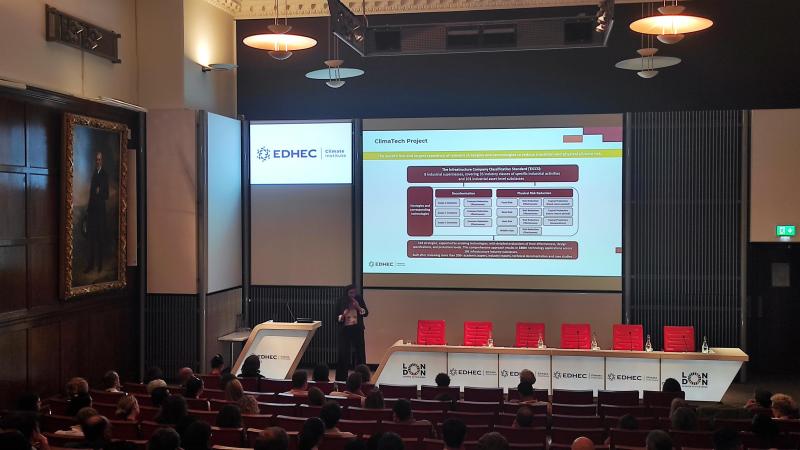
This challenge was the focus of the ‘ClimaTech’ session at the EDHEC Climate Research Conference. Presented by Nishtha Manocha, Project Lead of ClimaTech at EDHEC Climate Institute and COO of Scientific Climate Ratings (an EDHEC venture), the session explored how this database translates climate science and engineering expertise into practical, evidence-based guidance for investment decision-making. Below are the key takeaways.
Nishtha Manocha opened the session by sharing some striking statistics. A poll conducted by the EDHEC Infrastructure & Private Assets Research Institute revealed that 97% of surveyed infrastructure investors believe that physical climate risk is significant, and 76% anticipate that climate risk will have a medium or high impact on their investments. Yet only 16% of respondents believe they have the right tools and data to respond to climate risk.
ClimaTech, a database developed by the EDHEC Climate Institute (ECI), can provide these resources.
"Identifying the risk is the first step to reacting to it", Nishtha Manocha, Project Lead of ClimaTech at EDHEC Climate Institute
Nishtha Manocha then presented ClimaTech to the audience, which is the world's largest repository of resilience and decarbonisation strategies for infrastructure assets. The framework is built around the Infrastructure Company Classification Standard and covers 101 infrastructure asset subclasses. For each asset type, the ClimaTech team has identified relevant climate actions across both decarbonisation and physical risk reduction.
Crucially, the session clarified that the database does not simply catalogue the strategies, but assesses them based on factors such as effectiveness, engineering characteristics, design specifications, and implementation requirements. This means that not every measure makes the cut. ClimaTech focuses on what Nishtha Manocha called the "levers of decarbonisation", which are truly material interventions that deliver measurable climate outcomes.
As a final validation step, a diverse review committee verifies each measure to provide quality control, challenge the assumptions in the database, and help ensure that the outputs are robust, relevant, and usable by different types of decision-makers.
Nishtha Manocha demonstrated the value of this database and its applications through a real-world case study of an island airport that is heavily exposed to flood risk, developed in conjunction with Scientific Climate Ratings.
Filtering the full database for asset-specific measures revealed 49 available physical risk strategies. These were then shortlisted based on geography (what risks do assets in this location face?), materiality (are these risks material to this specific asset?), and contextual feasibility (are the relevant measures technically feasible, operationally realistic, and relevant in the broader policy or system context?). Finally, we removed the measures that have already been implemented. This left 11 prioritised strategies, which were then fed into the Scientific Climate Ratings framework to quantify the return on investment.
Without adjusting for resilience, the asset faced a net asset value loss of -12% and was assigned a ‘D’ Climate Risk Rating, reflecting considerable climate risk. However, when the relevant resilience measures were applied, the asset saw value growth of 7% and was assigned an adjusted Climate Risk Rating of ‘A’. In this instance, the insights afforded by ClimaTech and implemented by Scientific Climate Ratings make a clear case for resilience investment.
"The cost of inaction is far too high" , Nishtha Manocha, Project Lead of ClimaTech at EDHEC Climate Institute
The session demonstrated that ClimaTech's value lies in its combination of breadth and precision, offering a sector-specific, evidence-based database that distils a vast universe of potential adaptation measures into a few strategies that are genuinely material for a given asset. By providing a robust, scientifically grounded starting point, ClimaTech shifts the conversation from whether adaptation is necessary to how it should be implemented. And for decision-makers seeking to quantify the financial value of resilience, Scientific Climate Ratings (an EDHEC venture) goes one step further, leveraging the ClimaTech database to translate adaptation strategies into their impact on net asset value, expressing climate resilience in the universal language of finance.
And there’s more to come from ClimaTech. The database is soon extending to corporate assets. As climate adaptation moves from a strategic aspiration to a financial imperative, ClimaTech is positioning itself as the scientific foundation for turning climate risk into informed, investable action.