This document provides a synthesis of the full position paper “The Global Versus Local Identification of Macroeconomic Damages: Signal, Assumptions, Uncertainty[1]”, published by the EDHEC Climate Institute (June 2026). We strongly encourage readers to consult the full paper as well.
Key takeaways:
- Adrien Bilal and Diego R. Känzig’s “The Macroeconomic Impact of Climate Change: Global Versus Local Temperature” (QJE, 2026) challenges the conventional approach of estimating physical climate risk-induced macroeconomic damages.
- The paper argues that global temperature variation may capture a broader macroeconomic climate signal than local temperature variability alone, leading to substantially higher damage estimates than those reported in much of the established literature.
- The EDHEC Climate Institute (ECI) acknowledges the paper's contribution to the field at large. It nevertheless reaffirms the unique strengths of granular approaches, particularly their ability to capture spatial heterogeneity and decompose aggregate effects.
- Its value lies in testing whether standard local-temperature approaches may understate aggregate damages by missing common shocks or supply chain-propagated effects.
- Its limitation lies in the loss of heterogeneity information, diluted within an aggregate effect, that scenario users increasingly require.
Rapid background
Adrien Bilal and Diego R. Känzig’s paper, “The Macroeconomic Impact of Climate Change: Global Versus Local Temperature,” published in the Quarterly Journal of Economics in 2026, has become an important reference in the debate on macroeconomic climate damages. The paper departs from the standard panel-econometric approach, which identifies climate impacts from year-to-year variation in local temperature and GDP, and instead estimates both country- and global-level output responses as functions of global temperature variations. This change in the scale of the identifying climate signal is methodologically consequential: it produces substantially larger estimates of aggregate macroeconomic damages than those reported in much of the established local-temperature literature.
Given the unresolved uncertainty surrounding the macroeconomic cost of physical climate risk, Bilal and Känzig’s[2] findings should be examined with methodological care rather than dismissed as an outlier. The paper presents their global-temperature approach as a significant contribution that extends the upper range of scientifically accepted damage estimates; its NBER[3] version has already entered the Howard and Sterner meta-analysis[4], and its results could inform the next NGFS Phase VI, either as a benchmark estimate or as one input into a broader calibration of the physical-risk module.
The global approach: results and perspective
Bilal–Känzig instead reassess the scale at which temperature variation should enter the damage function, using global temperature variability to capture common climate shocks that local panel models may absorb or omit. The rationale is that macroeconomic damages may reflect not only direct local exposure, but also broader climatic disruption, extreme-event dynamics, and cross-border propagation through production networks (all unobserved in the data). On this interpretation, global temperature should not be viewed as a more precise measure of local physical risk, but as a broader proxy for systemic climate stress.
The paper estimates damages equating to approximately −19% of global GDP in a +1°C warming pathway by 2100. This compounds to a 45% loss in global GDP by 2100 under a 3°C warming scenario. The authors found that business-as-usual warming would result in a present welfare loss above 30% and a social cost of carbon exceeding $1,200 per ton of CO₂.
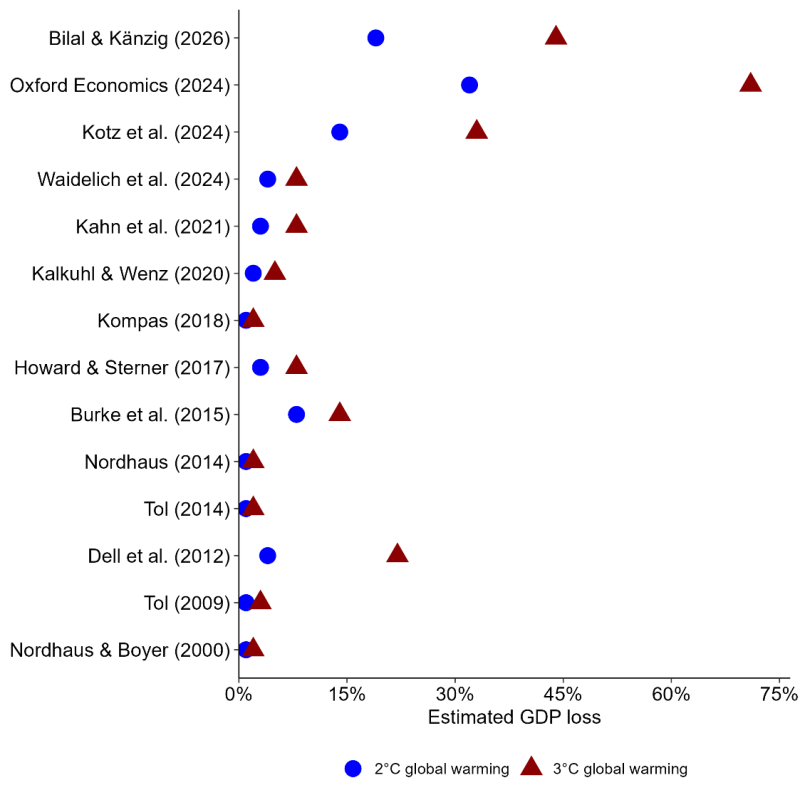
Figure 1 places Bilal–Känzig at the upper end of the current distribution of macroeconomic climate-damage estimates. The relevant comparator is Kotz et al. (2024), which had already represented a marked upward shift in projected damages, with an estimated global GDP loss of roughly 33% under 3°C warming. That estimate has since been questioned by the recent Nature retraction of the Kotz et al. (2024) paper, following concerns over data selection, model specification, and the sensitivity of the global result to an error affecting Uzbekistan. This episode does not invalidate the climate-economy literature[5]; it reinforces the need to assess high-damage estimates with methodological discipline. Against that benchmark, Bilal–Känzig goes further still, implying losses roughly 36% larger than Kotz et al. (2024) and extending the upper range of scientifically accepted damage estimates.
Figure 1: Estimates of GDP loss across the literature on macroeconomic damage functions.
Bilal–Känzig raise a legitimate challenge to the standard local-temperature literature: climate shocks may propagate through globally integrated production systems, so the macroeconomic impact of physical risk need not be limited to the weather conditions observed in isolation within a country’s borders. Supply-chain disruptions, trade linkages, and correlated extreme events may transmit losses across borders and amplify their aggregate effect beyond what is captured, at least explicitly, in the theoretical framework. In that sense, the hypothesis that a global-temperature approach may capture systemic climate stress only partially identified by local panel specifications seems both intuitive and attractive.
However, ECI’s position remains anchored in a spatially explicit framework. Physical climate risks materialise locally, through changes in weather distributions and climate normals, not through global mean temperature itself. The same global warming trajectory can generate very different regional risk realisations, while economic exposure, sectoral composition, and adaptive capacity vary across economies. For applied physical-risk assessment, this heterogeneity remains the empirical object to be quantified. The limitation of the Bilal–Känzig framework is therefore not that the global signal is uninformative. It is that the global time-series approach compresses heterogeneous physical exposures, propagation channels, and economic responses into a single temperature–GDP relationship. This may capture an aggregate climate signal, but it does so at the cost of spatial decomposition and of information on the channels, sectors, and adaptation margins through which damages materialise.
With ongoing advances in AI, geospatial data analytics, and high-resolution climate modelling, the momentum in physical climate risk assessment is moving toward greater spatial specificity, not away from it. The more relevant question is not whether granularity matters, but how it can be used rigorously to capture heterogeneous physical risks, sectoral exposures, and adaptation dynamics. That’s why across the breadth of the ECI’s output, we are providing stakeholders with increasingly granular products backed by these advancements. For instance, the ECI’s CLIRMAP (CLimate-Induced Regional MAcroimpacts Projector) product[6], which is underpinned by an ensemble of climate models and incorporates locally observed anomalies, allows stakeholders to map gross regional damages and uncover some aspects of this heterogeneity story.
As such, considerable questions remain. The ECI will monitor the literature for any further supporting research, but it does not intend to alter its methodologies at this time.
Implications for investors
If the Bilal–Känzig estimates were to materialise (i.e., 45% reduction in global GDP by the end of the century), the implications for our global macroeconomic system would be expectedly profound across most sectors and geographies.
ECI remains anchored in the standard panel-econometric literature developed over the past two decades. Its position is that physical climate risks materialise locally and unevenly: exposure, adaptive capacity, production structures, and sectoral composition differ across regions, sectors, and firms. For applied physical-risk assessments, this argues for granular climate fields and local temperature variation rather than a single global temperature statistic. Local variation preserves the spatial heterogeneity through which climate shocks affect output and therefore remains the natural basis for estimating climate-economy relationships in ECI’s framework.
The appropriate response is therefore not to replace one identification strategy with another, but to treat the Bilal–Känzig findings as part of a wider but relevant uncertainty set. Its value lies in testing whether standard local-temperature approaches may understate aggregate damages by missing common shocks or supply chain-propagated effects. Its limitation lies in the loss of heterogeneity information, diluted within an aggregate effect, that scenario users increasingly require.
Footnotes
[2] Bilal–Känzig hereafter.