Industry Trends & Analysis
Doing More with Less: How Infrastructure Investors Can Focus on the Climate Strategies that Really Work
Reading time
:
5mn

Doing More with Less: How Infrastructure Investors Can Focus on the Climate Strategies that Really Work

The infrastructure sector sits at the heart of the global climate challenge. It is responsible for a substantial share of global greenhouse gas (GHG) emissions – transport alone generates about 20% of the global total – and at the same time faces accelerating physical damage risks from the extreme weather events triggered by an evolving climate. Up to 54% of global infrastructure value may be at risk from climate-induced weather events if no adaptation is undertaken[1].
Yet despite this dual exposure, the industry’s response has been patchy at best. Fewer than a third of major infrastructure companies disclose credible emissions reduction strategies, and even fewer report meaningfully on climate resilience. Companies can all too often highlight strategies that are being deployed (such as improved waste management is or active mobility) but which have little meaningful impact on an asset’s carbon footprint.
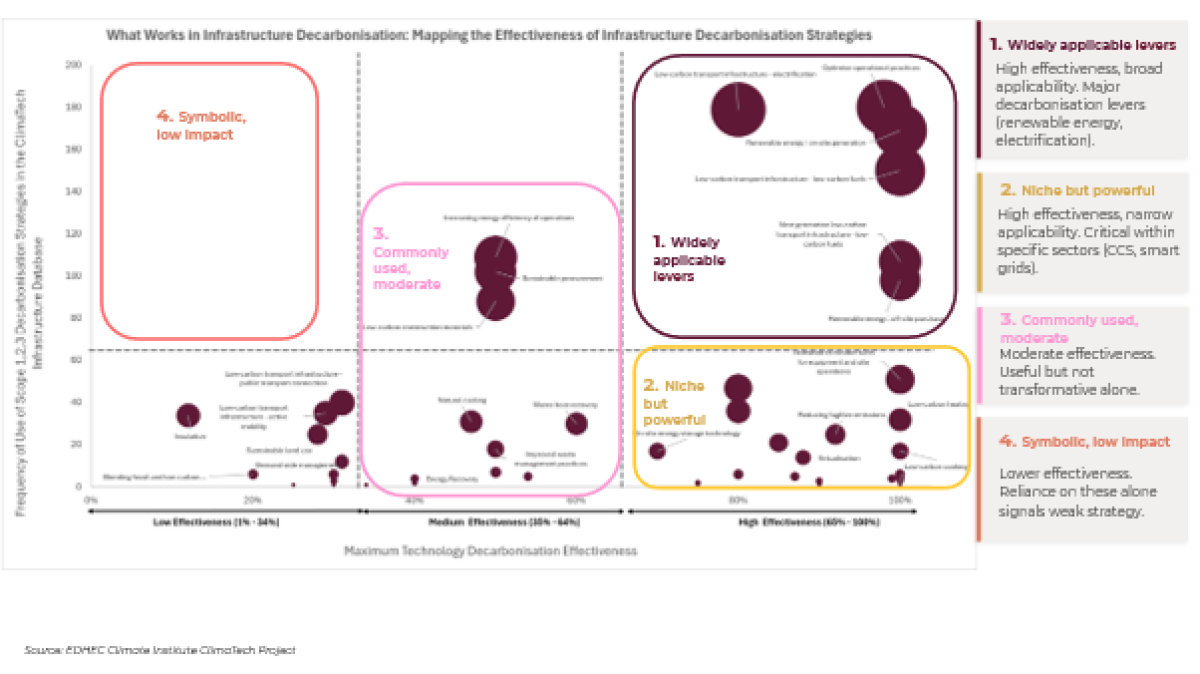
The research undertaken by EDHEC Climate Institute’s ClimaTech 2050 Project – which evaluated more than 100 decarbonisation and resilience strategies across 101 infrastructure asset subclasses – highlights this challenge. Mapping strategies by both their decarbonisation effectiveness and their frequency of use reveals four distinct clusters, with very different implications for investors, asset managers, and policymakers (Figure 1). It is worth noting that in the ClimaTech project, we focussed only on the most impactful strategies; however, in this note we also give an overview of the lower impact strategies that are popular in business practice – and some explanation to their popularity.
Figure 1: The best and the rest – deployment versus impact of “green” strategies
 |
Where the industry gets it right, the data is clear. A cluster of high-effectiveness strategies is both broadly applicable across infrastructure classes and already widely in use. These are the workhorses of infrastructure decarbonisation and deserve continued – and indeed accelerated – deployment. |
For example:
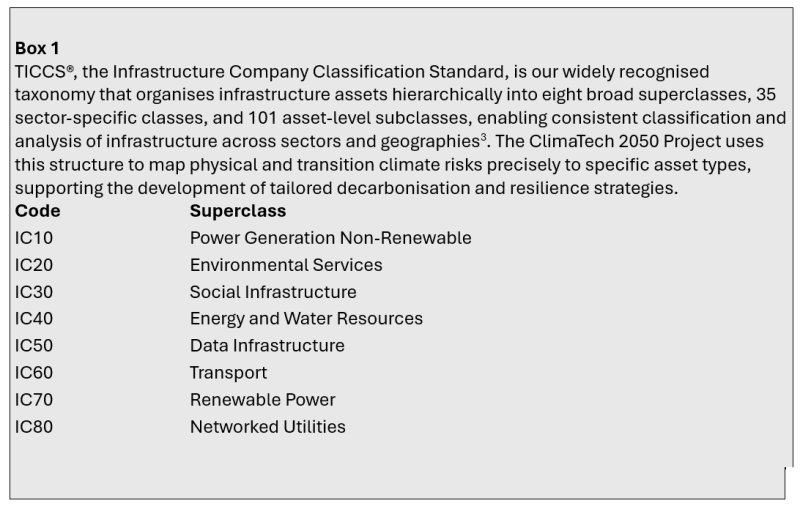
The strategies in this quadrant share critical characteristics: mature technology, proven economics, and broad applicability. Their prevalence in portfolios reflects rational decision-making and should continue to accelerate.
 |
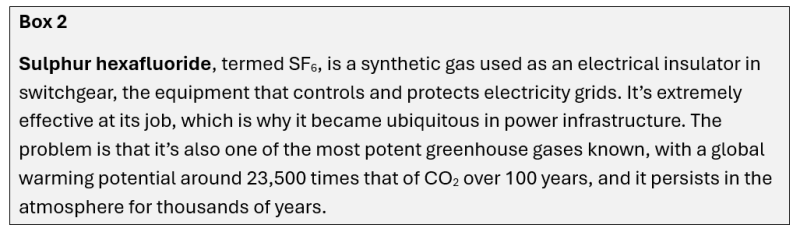
Some tools can have a genuinely transformative effect on an asset’s carbon credentials but are useful in only a narrow subset of assets. However, for those assets, they are transformational. Take-up can also be hampered by structural barriers such as poorly developed supply lines. |
For example:
 |
These are the strategies that have a modest but meaningful impact on reducing the carbon footprint of infrastructure and which have strong uptake. However, on their own they will not bring this asset class up to scratch when it comes to green credentials. |
For example:
 |
The strategies in this quadrant are widely deployed, often deliver diverse values, and are entirely legitimate components of an Environmental, Social, and Governance programme (see Box 3). However, they have little to no impact on an asset’s carbon footprint and can crowd out the real decarbonisation work. |
That’s why, when we put together the ClimaTech project, we decided not to focus on these strategies. Instead, we put our time and effort into those techniques and opportunities that give more bang for buck – and make a more impactful reduction to asset carbon footprints. Quadrant four is made up of measures that can give operational, social, or reputational benefits – but investors should be clear-eyed that meaningful carbon reduction is not among them.
For example:
The common thread here is that these strategies are accessible, reportable, and often genuinely beneficial to stakeholders – which explains their prevalence. These are legitimate tools, not be abandoned; the risk lies in allowing them to dominate a climate strategy at the expense of higher-impact action. For investors conducting due diligence, a portfolio narrative built primarily on these measures warrants a closer look.
It is also important to distinguish them from greenwashing tactics. This is when businesses represent themselves as more sustainable than they truly are, giving climate-positive optics to aspects of their business either by providing misleading information regarding a product’s sustainability or labelling business practices or products as “green” when they offer no climate advantage over what is already typical.
Greenwashing erodes trust and can have significant repercussions. Importantly, it is not a static concept – it occurs on a spectrum, ranging from outright deceit to wishful thinking, and adds yet another layer of complexity to gauging the climate credentials of investments. The EDHEC Climate Institute’s ClimaTech 2050 Project clearly grades “green” practices by their effectiveness, and our research has focussed on the tools that actually work, not on the ones that look good in a marketing leaflet.
Taken together, Quadrants One and Three show where infrastructure decarbonisation is genuinely working: mature, broadly applicable technologies are scaling, and procurement-led strategies are steadily improving the carbon profile of new build and refurbishment.
The picture changes in Quadrant Two. Here sit some of the single most powerful levers available to the sector, but their impact can be easy to overlook in a portfolio-level narrative. For investors with exposure to non-renewable power, gas and water networks, or electricity transmission, these niche strategies are not optional extras; they are often the single biggest determinant of whether a specific asset can credibly reach net zero.
Quadrant Four is the one to step away from when assessing real reduction in carbon footprints as they have little to no meaningful impact.
The pattern that emerges from this analysis has direct implications for how investors and asset managers should approach climate strategy in infrastructure portfolios.
Stepping back, the overall picture for infrastructure decarbonisation is one of real but uneven progress. The broadly applicable levers – electrification, renewable procurement, and operational efficiency – are scaling well and represent the sector's clearest success story; the technology is proven and adoption is accelerating. Moderate-impact, well-deployed strategies such as low-carbon materials and sustainable procurement are also moving in the right direction, even if their reach is inherently partial.
A cause for concern is the slow uptake of the highest-impact, asset-specific strategies such as carbon capture, smart grid technology, and fugitive emissions control. Here, the economics are sound but capital, infrastructure, and policy support have lagged the urgency of the opportunity. Climate-aligned infrastructure investment needs to help close this gap.
The EDHEC ClimaTech 2050 framework maps over 1,800 unique asset-strategy applications across 101 infrastructure subclasses. The intelligence exists to act precisely and effectively. Our intention is to provide investors with the strongest possible arsenal of tools for identifying which businesses are adopting strategies that actually reduce emissions – and those that are just going with what feels good or is easy to explain.
This article draws on findings from the EDHEC Climate Institute’s ClimaTech 2050 Project. Our overarching document “Reducing Infrastructure Climate Risk Through Technology Measures: An Overview” (Arnold, Hubert & Manocha, June 2025) summarises the findings of our research, while full methodology and sector deep dives are available at climateimpact.edhec.edu.
Footnotes
[1] https://edhec.infrastructure.institute/wp-content/uploads/2023/07/p1102…
[7] See https://www.sciencedirect.com/science/article/abs/pii/S0921344922004864 and https://www3.weforum.org/docs/WEF_Scaling_Low_Carbon_Design_and_Constru…
[9] Environmental, Social, and Governance – often termed ESG – is a framework that measures a company's impact and integrity across three dimensions that together determine long-term resilience and value, well beyond what the income statement alone can reveal. Quadrant Four is exactly where ESG’s broader value becomes visible.