- Hotels have hybrid characteristics of real estate and operational business assets, with climate risks concentrated in energy-intensive buildings, water use, and on‑site services while relying on tourist demand. This combination makes their cashflows more vulnerable to climate‑driven demand shocks.
- Climate risks to hotel asset values are being under recognised. Rising transition costs and more frequent floods, storms, heatwaves and wildfires mean some properties, including those held in REIT structures, may become stranded even if the buildings themselves survive.
- Hotel sustainability certification standards reference strategies that can reduce emissions and vulnerability to physical risk – but not how effective they are. Requirements vary widely by standard and by whether the focus is on transition or physical risks.
- EDHEC Climate Institute’s ClimaTech database makes it possible to test which of these standards actually capture effective, evidence-based strategies for climate‑risk reduction strategies in key activities.
- Our analysis shows that standards are reasonably good indicators of transition‑risk mitigation but provide only a patchy view of physical risk‑reduction, underlining the need for stronger physical‑risk metrics and paving the way for an activity‑based approach to climate ratings in hospitality and beyond.
This article examines which climate risk reduction strategies are most relevant to hotels and how far sustainability certification standards in the travel and tourism sector reflect them. Using EDHEC’s ClimaTech database, we show that existing standards already provide effective high-level indication of the use of transition risk-reduction strategies, but fail to provide clear insights into those for physical risk-reduction. (See here for the ClimaTech project overview and research papers.)
Climate-related financial and physical hazard risks can significantly threaten hotel asset values, both as real estate and operational businesses (Legrande, 2023; Lennox, 2024). The combination of more investible hotel stock with rising climate risks (IPCC, 2023) has increased the need to scrutinise hotels’ exposure.
Over the past 20 years, hotel groups have divested from direct property ownership in favour of ownership by real estate investment trusts (REITs) making hotels increasingly accessible and liquid investments (FasterCapital, 2025). The assets are typically then rented back under franchise and management agreements (Owen, 2024).
A growing number of environmental certification standards in the travel and tourism sector offer sustainability certification for hotels (Green Globe, 2014; GSTC, 2016; EarthCheck, 2022; Green Key, 2022). These third-party services confirm that a hotel is adhering to a set of operational requirements that address a range of social and environmental impacts, potentially incentivise owners and investors to reduce greenhouse gas emissions and improve hotels’ resiliency to the physical effects of climate change.
Against this backdrop, this article assesses how four of the better‑known hotel sustainability standards (Global Sustainable Tourism Council, EarthCheck, Green Globe and Green Flag) map onto the climate risk‑reduction strategies identified in the EDHEC Climate Institute’s ClimaTech project.
Characterising climate risks and solutions
Hotels operating costs and asset values are exposed to two key climate risks:
- Transition risks arise from a hotel’s greenhouse gas emissions. They can affect operating costs through instruments designed to discourage emissions, including carbon taxes and regulatory requirements. They can also influence customers’ perception of an asset’s environmental impacts, which, if poor, can drive down patronage and revenue.
- Physical risks arise from damage caused by natural events exacerbated by climate change, including floods, storms, heatwaves and wildfire (United Nations Office for Disaster Risk Reduction, 2020). Their predicted increased frequency and intensity (IPCC, 2021), can drive up maintenance and repair costs, degrade or halt operations through supply chain interruptions, and potentially increase insurance costs (FasterCapital, 2023).
Studies of a representative set of infrastructure assets suggest that climate risks could result in average value losses of up to 54% from physical risk and 30% from transition risks (Blanc-Brude et al., 2023).
Understanding these risks and appropriate actions to reduce them is thus key to investment decisions for asset owners and operators. EDHEC Climate Institute developed the ClimaTech project to meet this need.
ClimaTech links a classification of 101 types of infrastructure asset types, based on the industry standard TICCS® (The Infrastructure Companies Classification Standard) taxonomy (Blanc-Brude and Whittaker, 2022), to a framework of technology-based strategies to reduce assets’ transition and physical climate risks (EDHEC Climate Institute, 2025).
ClimaTech provides a broad, comparable assessment of leading strategies and technologies that reduce climate risks to infrastructure. Hotels’ infrastructure-like physical characteristics enable us to use ClimaTech to identify their main climate risks, effective strategies to reduce them and the subsequent climate resilience benefits.
Beyond just buildings – how does climate change affect hotels?
Hotels comprise accommodation, grounds and amenities such as restaurants and recreational facilities, so they share characteristics with other commercial real estate (CRE) and the TICCS® “Social Infrastructure” asset superclass used by ClimaTech.
Many CRE assets, such as offices, depend on long-term leases offering steady, stable revenue. Hotels, by contrast, depend on continuous customer patronage to generate revenue from room rental, catering and recreational services. This revenue is more volatile than that of other types of CRE, making hotels a hybrid of real estate and operating business (Liu and O’Neill, 2023).
Customer choice in hotels is influenced by service quality and comfort, the carbon impact of a hotel’s operation and its location’s physical climate risks (HOTREC, 2024; Kirk, 2024). These physical risks include the likelihood of disasters such as floods or wildfires, but also less acute climate-related weather impacts, such as insufficient snowfall at ski resorts or increased rainfall at beaches. Consequently, hotel revenue and investment returns are more vulnerable than most other CRE assets to the types of operational disruptions and business risks that can result from climate change (Fox, 2025).
Rising risks of emissions
Hotels use many energy intensive activities to support operations and maintain customer satisfaction (Lennox, 2024) and these define their greenhouse gas emissions and transition risk.
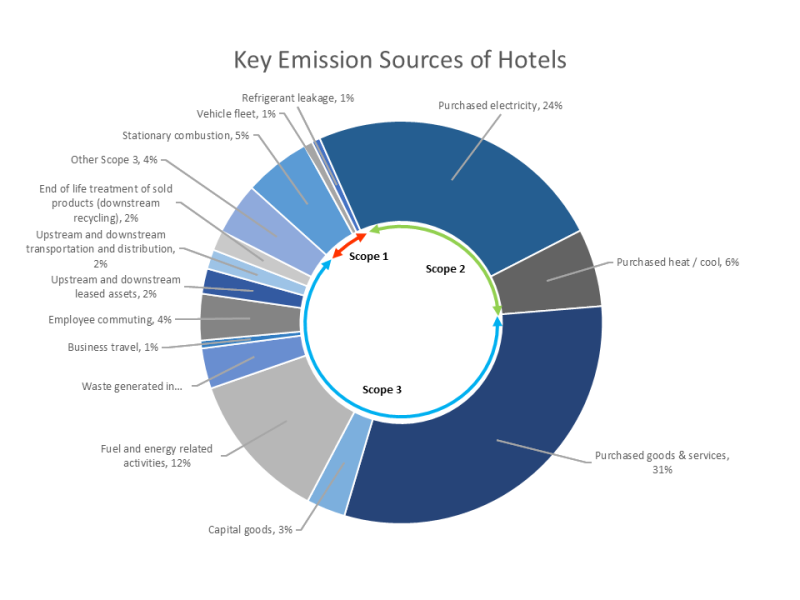
Figure 1 shows the breakdown of hotel emission sources across Scope 1, 2 and 3, based on data on around 35,000 hotels from global brands operating a spectrum of properties from budget hotels to luxury reports. This represents the average emissions of each group’s hotels, weighted by the number of properties each group owns.
Figure 1: Breakdown of key Scope 1, 2 and 3 emission sources of a representative hotel
Source: Hyatt Hotels, 2023; Radisson Hotel Group, 2023; Sonesta International Hotels, 2023; The Indian Hotels Company Limited, 2023; Choice Hotels, 2024; Hilton Hotels, 2024; InterContinental Hotels Group PLC, 2024; Whitbread PLC, 2024; Minor International (MINT), 2024; NQA Certification Ltd, 2025; Wyndham Hotels, 2025.
Scope 1 and 2 emissions arise from on-site sources such as the site’s vehicle fleet, lighting, cooking, laundry, HVAC (heating ventilation and air conditioning), and leisure facilities such as swimming pools, spas and sports facilities. These emissions are from equipment owned by the hotel operator and are within the hotel’s direct control. They represent a financial risk, as the electricity and fuels they use are frequently subject to environmental taxes that get passed through to the customer (Umwelt Bundesamt, 2023; Kynett, 2024) and are subject to price volatility through global markets.
Most Scope 1 and 2 activities must run continuously and are challenging to scale back without harming service quality, customer satisfaction or safety. One can reduce HVAC only by a limited amount before rooms become uncomfortable, and there is a limit to reducing the amount of laundry per guest stay before acceptable hygiene levels are compromised. Consequently, hotels must rely heavily on technological solutions such as equipment efficiency, low-carbon energy, and procurement choices to reduce emissions. HVAC solutions can include advanced control systems, efficient equipment and new refrigerants (Harman, 2025); key opportunities for laundry include low-temperature, water-efficient washing, energy efficiency and waste heat reclamation (InterContinental Hotels Group PLC, 2023; Cleamondblue, 2025).
Scope 3 emissions arise from outsourced and supply chain activities, including food provision, waste disposal, materials for maintenance, cleaning and renovation, and employee transport. Hotels can reduce these by choosing appropriate suppliers and specifying lower‑carbon products and services.
Emissions generated by tourists' travel to and from the destination also contribute significantly to their overall environmental footprint (World Tourism Organization and International Transport Forum, 2019). Whilst corporate and commuter travel are often included in reported emissions, such as those listed in Figure 1, emissions from customer travel is often excluded and thus unquantified.
A high sensitivity to physical risks
Hotels are also highly vulnerable to physical climate risks, which can impose significant repair and maintenance costs, with substantial interruptions to revenue. Flooding and wind damage are well-known causes of structural damage (Fox, 2025), that can compromise building safety and lead to prolonged business interruptions during remediation.
Heatwaves can overwhelm cooling systems, reducing indoor comfort and increasing the chance of electrical equipment failures and power outages (Alpine Intel, 2025; UK Government, 2025). Wildfires can cause structural damage or destruction, evacuations and transport disruption, as occurred in 2025 around the Grand Canyon (Debusmann and Yousif, 2025). Smoke and ash can contaminate HVAC systems and interior spaces, forcing temporary closure and reducing occupancy and revenue.
The chronic impacts of climate change, such as higher seasonal temperatures, may also affect hotel revenues in established destinations. In Spain, for example, geographical and seasonal shifts in tourism appear to reflect visitors increasingly favouring cooler areas of the country in summer or avoiding the hottest times of the year. (Barrutiabengoa et al., 2024).
Risks may be being ignored
Despite such sensitivity to climate costs and disruption, there is evidence of these risks being ignored in hotel development and investment, particularly in the luxury end of the market (Lee, 2023; Legrande, 2023). Consequently, investors may benefit from simple tools to identify whether hotel assets are taking measures to address climate risks.
Applying ClimaTech to hotel standards
Tourism sustainability standards for hotels can highlight climate risks and opportunities to reduce them. To test this, we assessed how these standards reflect ClimaTech’s risk-reduction strategies.
We consider four standards:
- The Global Sustainable Tourism Council industry criteria for hotels and accommodation (GSTC Hotel standard) (GSTC, 2016)
- The Earthcheck Company Standards (Earthcheck, 2022)
- The Green Globe Certification Standard - Hotels & Resorts (Green Globe, 2014)
- The Green Key Criteria for hotels and hostels (Green Key, 2022)
Each one sets out a broad range of environmental and social requirements. Environmental criteria often cover energy supply and use, water consumption, waste management, physical resilience, alongside broader issues such as biodiversity. By mapping these requirements to ClimaTech strategies, we can evaluate how compliance with each standard reflects credible actions to reduce hotels’ climate risks.
ClimaTech Strategies for hotels
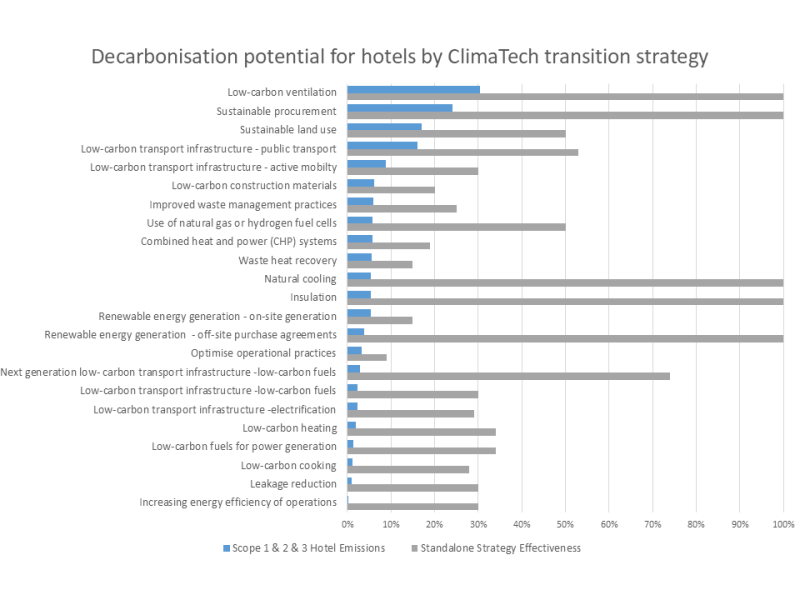
Figure 2: ClimaTech transition strategies applicable along with their decarbonisation strategy effectiveness
Source: EDHEC Climate Institute, 2025.
Figure 2 summarises ClimaTech strategies relevant reducing hotels’ transition risk, showing their standalone “strategy effectiveness” – the maximum emissions reduction potential that each strategy offers for the sources it addresses. By combining these with the emissions profile of an average hotel, we show the reduction potential for an average hotel’s carbon footprint across Scope 1, 2 & 3 emission sources.
This breadth of strategies helps identify which approaches are most likely to significantly reduce hotels’ total emissions footprint and thus maximise transition risk reduction. Renewable energy offers some of the greatest opportunities and flexibility across all emissions scopes, as it can address many sources of emission and its use is an enabling action for many of the other strategies. Low carbon ventilation, low carbon construction materials and energy efficiency are also high impact strategies, although only the last of these is as flexible a strategy as renewable energy.
The most effective standalone strategies are not always those with the greatest impact on hotel emission footprints. Using low carbon fuels for power generation and for transport, or electrifying transport infrastructure provide relatively little impact on a hotel’s overall emissions, despite their capability to achieve up to total decarbonisation of the sources they address. Such strategies still play a role in transition risk reduction, but decisions to stress their importance in environmental reporting may be misleading.
Hotel standards’ relationship with ClimaTech
The hotel standards considered reflect ClimaTech strategies in two ways:
- Explicitly, where ClimaTech strategies are reflected in obligatory, overtly stated requirements for compliance, such as the use of renewable energy. These actions are considered essential to a hotel securing certification under a standard and their descriptions often match those of strategies or technologies in ClimaTech.
- Implicitly, where ClimaTech strategies are valid ways of fulfilling wider-ranging compliance criteria, but no specific strategy can be considered obligatory. General requirements to monitor and reduce significant sources of greenhouse gas emissions are an example.
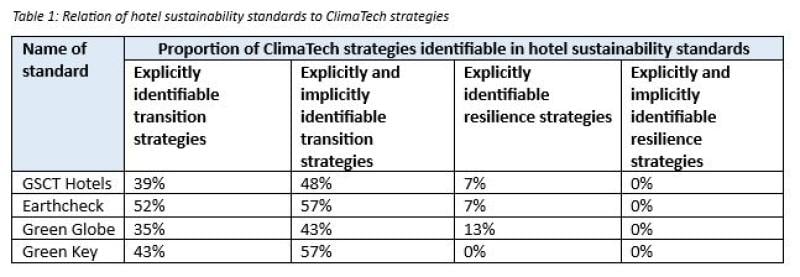
An overview of the number of identifiable strategies in each standard is presented in Table 1.
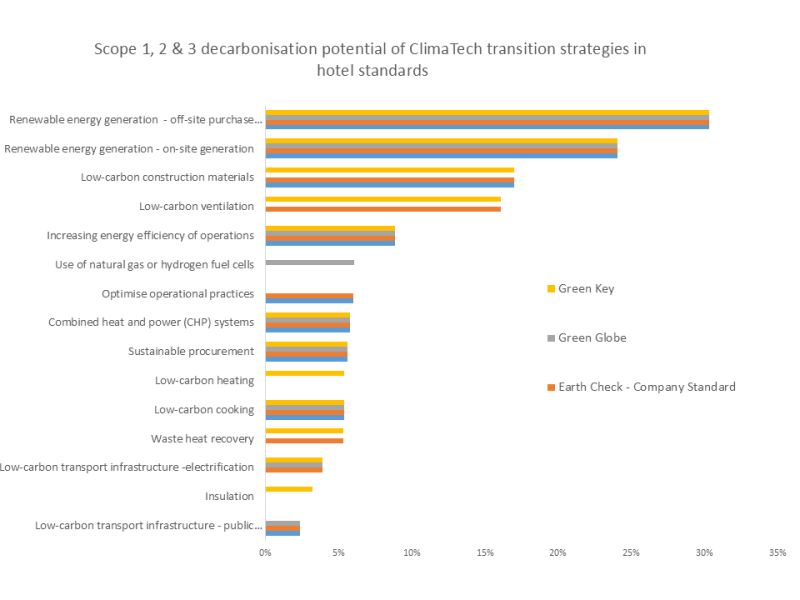
We gauge each standard’s relevance for transition risk reduction by how much of a hotel’s total emissions its explicit and implicit ClimaTech strategies could decarbonise. The technical effectiveness of each strategy is applied to the relevant emission sources to give the proportion of emissions each strategy can address (the “decarbonisation potential”) for each source of a hotel’s emissions.
The greater the proportion of high reduction potential strategies, the better a standard reflects a hotel’s efforts to reduce transition risks. Explicit strategies represent a greater certainty that compliant hotels are taking specific transition risk reduction action, whilst implicit strategies indicate what a hotel could achieve if it deploys ClimaTech strategies aligned to the standard’s requirements.
This approach shows that hotel standards represent ClimaTech transition strategies reasonably well, with more than half of them explicitly identifiable in the EarthCheck standard and more than one third of them in the other standards. This proportion increases when implicit strategies are also accounted for. Overall, the standards have similar coverage of ClimaTech transition risk strategies – all in the 40-60% range, but varying by the strategies they include.
The first three of the four highest impact strategies across all scopes (energy efficiency and on-site and off-site renewable energy) are explicitly represented in all the standards, but only EarthCheck explicitly requires the fourth – low carbon ventilation. The next highest impact strategies – low carbon construction materials and sustainable procurement – apply only to Scope 3 emissions but are also well represented, with the former reflected in three of four standards and the latter in all.
The impacts of some strategies, such as efficiency, ventilation and renewable energy are interdependent, so their impacts do not add up linearly. However, as construction materials and procurement are independent of energy consumption, we can conclude that the most impactful strategies in the standards can reduce hotels’ transition risk for up to 70% - 80% of Scope 1 and 2 emissions and up to around 50% of Scope 1, 2 and 3 emissions.
Furthermore, hotel standards contain decarbonisation measures that do not appear in ClimaTech, because their low contribution to emissions reduction results in them being perceived as immaterial to reducing transition risks. This includes actions such as installing LED lighting, or recycling office paper and toner (Green Globe, 2014; Green Key, 2022). Whilst these do not automatically contribute substantively to a hotel’s emissions budget, their inclusion is appropriate, as these measures represent a baseline for good practice and may not be considered business as usual in all locations.
Figure 3: The proportion of overall hotel emissions each ClimaTech strategy identifiable in hotel sustainability standards can address
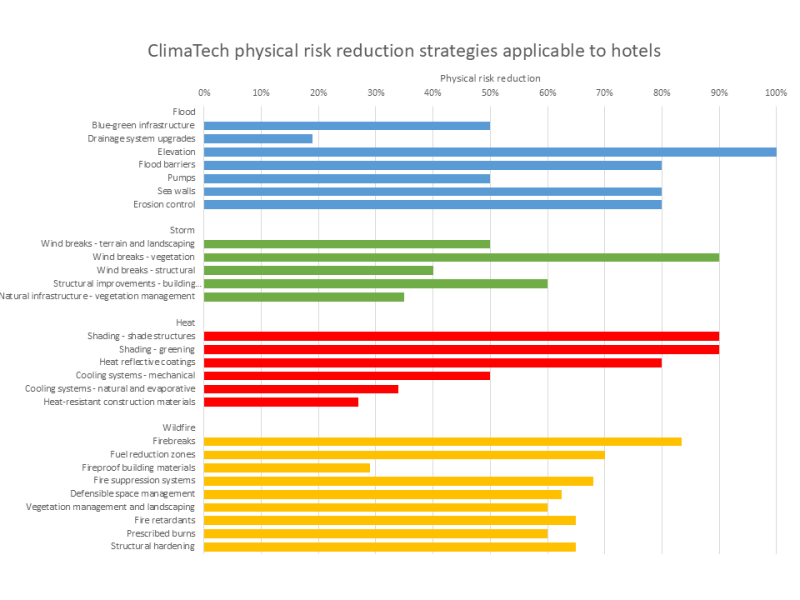
An overview of the ClimaTech strategies applicable to hotels for physical risk reduction is provided in Figure 4. These estimate the reduction of damage a hotel will suffer from flood, storm, heat and wildfire events as the result of the strategy. The full set of ClimaTech strategies provides a broad, flexible selection of effective protection strategies. When used in conjunction with each other, they can offer substantial against climate hazards.
Figure 4: ClimaTech physical risk reduction strategies applicable to hotels
Source: EDHEC Climate Institute, 2025.
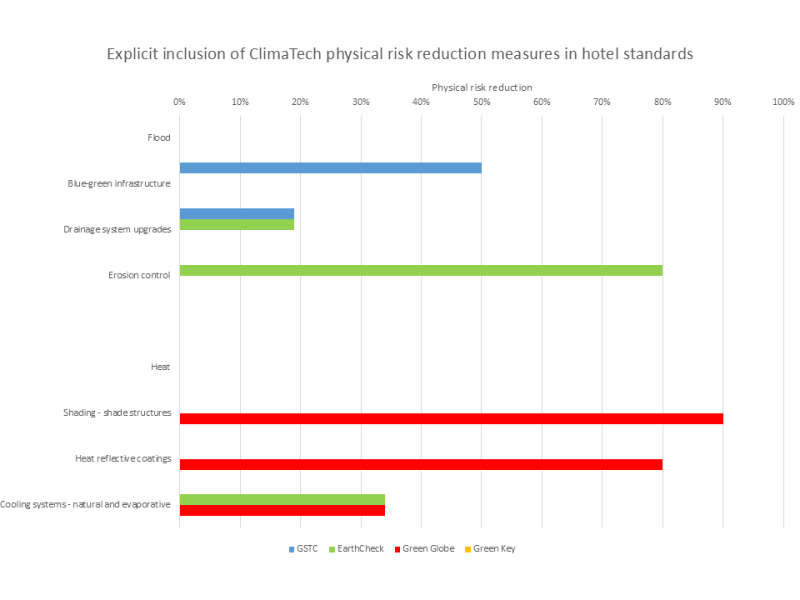
There are fewer ClimaTech physical risk reduction strategies identifiable in hotel standards than there are for transition. Protective strategies against storms and wildfires are absent. Only strategies against floods and heat are mentioned explicitly in the hotel standards considered here, and these are presented in Figure 5.
Figure 5: Explicit inclusion of ClimaTech physical risk reduction measures in hotel standards
We take the same approach in identifying explicit and implicit strategies as for transition risk reduction strategies, but since none of the standards have requirements that imply the use of unstated resilience measures, we only present explicit strategies. There is very little commonality between standards for inclusion of resilience strategies, with only natural and evaporative cooling and upgrades to drainage represented in more than one standard. However, many strategies, such as elevation or mechanical cooling, are unrepresented.
This suggests that standards are ineffective in identifying whether a hotel has improved resilience against physical risks. However, GSTC, EarthCheck and Green Globe can identify where some actions have been taken to protect hotels against specific modes of attack from physical hazards.
Notably, resilience measures do not always have physical protection of the hotel as their primary objective. For instance, the shading measures specified by Green Globe aim to reduce solar gain in buildings and lower the cooling load and energy use, even though this should also lower the potential for damage to overloaded HVAC equipment. Despite this, shading remains one of the most highly effective physical protection measures in ClimaTech and the most effective one explicitly included in hotel standards.
Can hotel sustainability standards offer a snapshot of climate risks?
Hotels concentrate multiple climate risks in a single asset class that is both real estate and an operating business with hybrid characteristics that make revenues more volatile than in most other commercial property. Customers – and cashflows – can walk away from that business far faster than an office tenant can break a lease. As climate shocks intensify, tourists and tourism companies are already shifting destinations and formats, from hotel stays to alternative rentals or, in the case of the luxury segment, into cruise ships, so investors cannot assume that today’s high‑value locations or branded properties will hold their appeal or cashflows.
As climate change drives more frequent floods, storms, heatwaves and wildfires, this mobility of tourism demand increases the risk that hotel properties, especially those held in REIT structures and effectively “rented” back to operators, can become stranded assets, even if the buildings themselves still stand.
In this setting, hotel sustainability standards matter because they are the main tools many investors use to read climate risk, yet the ClimaTech analysis shows that they capture high‑impact transition strategies reasonably well but give only a patchy view of physical resilience.
Using ClimaTech to scrutinise hotel standards’ requirements enables investors to see which technologies and practices deliver material reductions both to emissions and damage risks in this uniquely footloose segment of commercial real estate. It points the way to extending this activity‑based, evidence‑driven approach to climate ratings across the wider hospitality and corporate universe.
References
-
Alpine Intel (2025) Why the Increase in Heat Waves Could Affect Claims. Available at: https://alpineintel.com/resource/why-the-increase-in-heat-waves-could-a… (Accessed: 29 December 2025).
-
Barrutiabengoa, J., G. Carta, N. González, D. Pérez, P. Más and G. Yücel. (2024) The Impact of Climate Change on Tourism Demand in Spain. Available at: https://www.bbvaresearch.com/en/publicaciones/spain-the-impact-of-clima… (Accessed: 14 January 2026).
-
Blanc-Brude, F. et al. (2023) It’s Getting Physical. EDHEC Infra & Private Assets Research Institute. Available at: https://edhec.infrastructure.institute/wp-content/uploads/2023/07/p1102… (Accessed: 10 January 2024).
-
Blanc-Brude, F. and Whittaker, T. (2022) The Infrastructure Company Classification Standard (TICCS). Report. EDHECInfra.
-
Choice Hotels (2024) Building a Better Tomorrow Today - 2024 Sustainability Report. Available at: https://s201.q4cdn.com/538915302/files/doc_downloads/2024/Choice-Hotels… (Accessed: 15 December 2025).
-
Cleamondblue (2025) ‘Sustainability in Linen Laundry: How to Reduce the Environmental Impact in Hotels and Spas’, 15 January. Available at: https://www.cleamondblue.com/sustainability-in-linen-laundry-how-to-red… (Accessed: 20 December 2025).
-
Debusmann, B. and Yousif, N. (2025) Grand Canyon Lodge destroyed amid raging Arizona wildfires, BBC News. Available at: https://www.bbc.co.uk/news/articles/c33527p2nzeo (Accessed: 13 January 2026).
-
Earthcheck (2022) ‘Earthcheck Company Standard v4.1’. Available at: https://earthcheck.org/resources/ (Accessed: 2 December 2025).
-
EDHEC Climate Institute (2025) ClimaTech Project. Available at: https://climateinstitute.edhec.edu/climatech-project (Accessed: 12 December 2025).
-
FasterCapital (2023) Bridge resilience and insurance: Protecting against natural disasters.
-
FasterCapital (2025) Hospitality Sector: Investing in Comfort: The Rise of Hospitality Sector REITs, FasterCapital. Available at: https://fastercapital.com/content/Hospitality-Sector--Investing-in-Comf… (Accessed: 28 December 2025).
-
Fox, C. (2025) ‘Lanzarote floods prompt holiday cancellations amid emergency response’, International Travel Health & Insurance Journal [Preprint]. Available at: https://www.itij.com/latest/news/lanzarote-floods-prompt-holiday-cancel… (Accessed: 13 January 2026).
-
Green Globe (2014) ‘Green Globe Certification Standard Hotels & Resorts V1.7’. Available at: https://www.greenglobe.com/green-globe-standard (Accessed: 10 December 2025).
-
Green Key (2022) ‘Green Key Criteria and explanatory notes - Hotels & Hostels’. Available at: https://www.greenkey.global/criteria (Accessed: 2 December 2025).
-
GSTC (2016) ‘GSTC Industry Criteria with Performance Indicators For Hotels and Accommodations and corresponding SDGs’. The Global Sustainable Tourism Council. Available at: https://www.gstc.org/gstc-criteria/gstc-industry-criteria-for-hotels/ (Accessed: 10 December 2025).
-
Harman, J. (2025) Green Rooms trend in hotel sustainability and energy efficiency. Available at: https://les.mitsubishielectric.co.uk/the-hub/green-rooms-trend-in-hotel… (Accessed: 20 December 2025).
-
Hilton Hotels (2024) 2024 Travel with Purpose Performance Tables.
-
HOTREC (2024) Crisis Resilient Guidelines for Hospitality Sector, HOTREC – European Hospitality. Available at: https://www.hotrec.eu/en/news/crisis_resilient_guidelines_for_hospitali… (Accessed: 15 December 2025).
-
Hyatt Hotels (2023) ‘Environmental Data Summary’.
-
InterContinental Hotels Group PLC (2023) Responsible Business Report 2023. Available at: https://www.ihgplc.com/en/responsible-business/reporting (Accessed: 20 December 2025).
-
InterContinental Hotels Group PLC (2024) Responsible Business Report 2024 and Performance Data. Available at: https://www.ihgplc.com/en/responsible-business/reporting (Accessed: 12 December 2025).
-
IPCC (2021) ‘Climate Change 2021 – The Physical Science Basis: Working Group I Contribution to the Sixth Assessment Report of the Intergovernmental Panel on Climate Change’. Intergovernmental Panel on Climate Change (IPCC).
-
IPCC (2023) ‘Climate Change 2023: Synthesis Report. Contribution of Working Groups I, II and III to the Sixth Assessment Report of the Intergovernmental Panel on Climate Change’.
-
Kirk, P. (2024) How climate-related events are influencing hotel investment | Hospitality Investor. Available at: https://www.hospitalityinvestor.com/esg/how-climate-related-events-are-… (Accessed: 15 December 2025).
-
Kynett, K.G. (2024) The California Cap-and-Trade Program: Overview and Considerations for Congress. Available at: https://www.congress.gov/crs-product/R48314 (Accessed: 29 December 2025).
-
Lee, I. (2023) Investor appetite for luxury hotels continues despite environmental challenges | Hospitality Investor. Available at: https://www.hospitalityinvestor.com/esg/investor-appetite-luxury-hotels… (Accessed: 29 December 2025).
-
Legrande, W. (2023) Developing and Valuing Hotels: still ignoring climate risks?, Hospitality Net. Available at: https://www.hospitalitynet.org/viewpoint/125000208.html (Accessed: 20 December 2025).
-
Lennox, Z. (2024) Why hotel industry must get sustainability right, Royal Institute of Chartered Surveyors. Available at: https://ww3.rics.org/uk/en/journals/property-journal/hotel-industry-sus… (Accessed: 20 December 2025).
-
Liu, P. and O’Neill, J.W. (2023) ‘Do Brand-Affiliated Hotels Have Lower Cash-Flow Risk?’, Cornell Hospitality Quarterly, 64(3), pp. 363–380. Available at: https://doi.org/10.1177/19389655221102385.
-
Minor International (MINT) (2024). Available at: https://www.minor.com/en/flipbook/910/sustainability-performance-data-2… (Accessed: 14 December 2025).
-
NQA Certification Ltd (2025) ‘ISO 140641 Verification Opinion Statement Millennium Hotels’. Available at: https://mc-6411c2dd-ed8a-41b8-8a34-7690-cdn-endpoint.azureedge.net/mhb-… (Accessed: 14 December 2025).
-
Radisson Hotel Group (2023) Responsible Buisiness Report 2023. Available at: https://www.radissonhotels.com/en-us/corporate/responsible-business/pol… (Accessed: 10 December 2025).
-
Sonesta International Hotels (2023) Sonesta ESG Report 2022 - 2023. Available at: https://www.sonesta.com/esg-sonesta (Accessed: 17 December 2025).
-
The Indian Hotels Company Limited (2023) Business Responsibility & Sustainability Report. Available at: https://ir.ihcltata.com/media/dv2d5hmg/ihcl_brsr_2022-23.pdf (Accessed: 23 December 2025).
-
UK Government (2025) Impacts on energy assets from extreme heat and heatwaves. CS-N0W WPG8. Department of Energy Security and Net Zero. Available at: https://www.gov.uk/government/publications/impacts-on-energy-assets-fro… (Accessed: 29 December 2025).
-
Umwelt Bundesamt (2023) DEHSt - nEHS for heating and transport - nEHS for heating and transport. Available at: https://www.dehst.de/EN/Topics/nEHS/nEHS-heating-transport/nehs-heating… (Accessed: 29 December 2025).
-
United Nations Office for Disaster Risk Reduction (2020) ‘The Human Cost of Disasters’. United Nations Office for Disaster Risk Reduction.
-
Whitbread PLC (2024) Whitbread PLC Environmental, Social and Governance Report 2023/24. Available at: https://www.whitbread.co.uk/governance/reports-policies/ (Accessed: 27 December 2025).
-
World Tourism Organization and International Transport Forum (2019) Transport-related CO2 Emissions of the Tourism Sector – Modelling Results. World Tourism Organization and International Transport Forum. Available at: https://doi.org/10.18111/9789284416660.
-
Wyndham Hotels (2025) 2025 CORPORATE RESPONSIBILITY REPORT. Available at: https://investor.wyndhamhotels.com/corporate-responsibility/corporate-r… (Accessed: 15 December 2025).