News
Inaugural EDHEC Climate Research Conference 2026 – Climate Risk and Business Resilience: From Science to Strategic Action
Reading time
:
2mn

Inaugural EDHEC Climate Research Conference 2026 – Climate Risk and Business Resilience: From Science to Strategic Action
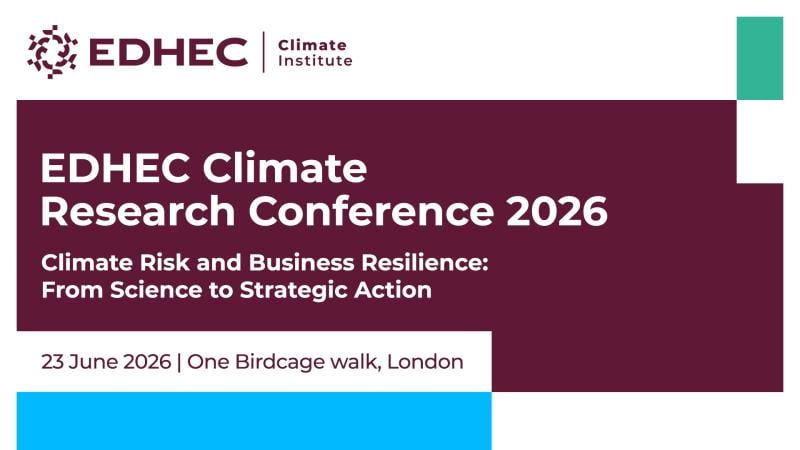
On 23 June 2026, the EDHEC Climate Institute will host its flagship Climate Research Conference at One Birdcage Walk in London, bringing together leading academics, regulators, investors, and industry experts to explore how climate science can drive strategic action across finance and the real economy.
Climate change is no longer a distant or theoretical concern. It is already disrupting operations, damaging infrastructure, altering supply chains, and eroding asset values. As trillions of dollars in global assets face potential losses, investors and corporates must move beyond high-level scenarios to quantify, localise, and manage climate risks with scientific precision.
The conference will address the core questions shaping financial decision-making and regulatory policy in the age of climate risk:
Through high-level keynotes, technical sessions, and real-word case studies, participants will explore how rigorous, data-driven insights can translate into tangible resilience strategies for investors, corporates, and regulators.
Keynote Address – Professor Riccardo Rebonato
Conceptual and Technical Challenges in Evaluating Climate Change Impact on Capital Markets
Professor Rebonato will examine how climate uncertainty and tipping points challenge traditional asset valuation models, and how probabilistic, state-dependent approaches can better capture systemic risk across capital markets.
Session 1 – Assigning Probabilities to Climate Scenarios
EDHEC Climate Institute researchers will introduce a methodology to assign explicit probabilities to climate trajectories, refining existing NGFS pathways and enabling more realistic, geo-sectoral scenario analyses.
Session 2 – Hyperlocal and Granular Consequences of Climate Change
This session will showcase how high-resolution satellite and geospatial data can reveal differentiated vulnerabilities across regions and sectors, highlighting the materiality of local climate risks for financial decision-making.
Session 3 – Applied Case Studies
Case Study 1: Scientific Climate Ratings - Quantifying Climate Risk for Infrastructure: quantifying physical and transition risks for infrastructure assets through a forward-looking, evidence-based framework.
Case Study 2: Scientific Portfolio (EDHEC Venture) - Physical climate risk in equity markets : quantifying region-sector heterogeneity and designing climate resilient equity indices
Session 1 – Research-Driven Resilience: ClimaTech Strategies to Protect Industries from Physical Climate Risk
The ClimaTech project presents a comprehensive taxonomy assessing over 100 resilience strategies across 101 infrastructure types, aligned with EU taxonomy and CSRD principles. It identifies which strategies are effective, for which sectors, and for which risks.
Session 2 – Transition Risk Beyond Carbon Tax
This session extends traditional carbon-pricing models to include geopolitical, regulatory, and technological dimensions of transition risk, providing a more complete understanding of sector-specific exposure.
Session 3 –Applied Case Studies
Case Study 1: Blue Dot Project: Demonstrate, through a real infrastructure case study, how a Blue Dot Network (BDN) certified project can align with and benefit from the ClimaTech and Scientific Climate Ratings methodology. Illustrate how these strengthens the assessment of physical and transition climate risks across the project lifecycle, improving decision-making and resilience planning.
Case Study 2: EDHEC Climate Institute x Climate Innov - Flood Risk Intelligence: combining AI and satellite analytics to model short- and medium-term flood risks.
5.30pm - 7:00pm COCKTAIL & NETWORKING
With trillions of dollars in global asset value at risk, the EDHEC Climate Research Conference aims to bridge the gap between science and finance—providing the independent, evidence-based insights needed to drive meaningful climate action.
We are currently inviting sponsorship partners and speakers to join us in shaping this pivotal event. Sponsors will benefit from high-level visibility among global climate, finance, and policy audiences, while speakers will have the opportunity to share insights that drive real impact.
For partnership and speaking opportunities, please contact Joanne Finlay at [email protected].
You can download the programme, here.
To register, please visit the dedicated registration page.